YumYum Gifts · Ordering guides
Different Names on Your Families’ Betrothal Lists? Match the Seafood and Fruit Before Ordering
For this guide:Different Names on Your Families’ Betrothal Lists? Match the Seafood and Fruit Before Ordering
Arrange a thoughtful gift
Considering Chinese betrothal gifts? Send the date, district and the points discussed in this guide to YumYum Gifts to confirm suitable options and a quotation.
Order Your GiftWhatsAppThis opens a prepared WhatsApp enquiry. Availability, details and price must be confirmed before booking.
One family sends a handwritten list mentioning 海味金 and 京果. The other sends a message asking for a seafood hamper and fruit. Both may sound like familiar Guo Da Li preparations, but ordering straight from those descriptions leaves important questions unanswered: are the families requesting alternatives, separate gifts, or the same items under different names?
If you are working out how to reconcile two family betrothal gift lists, start by putting the two versions beside each other without rewriting either one. Your immediate task is not to choose the most attractive basket. It is to identify what each family means, what will physically be presented, and which decisions still need approval. The method below produces a usable joint list while keeping seafood, fresh fruit, dried goods and separate wedding presents in their proper places.
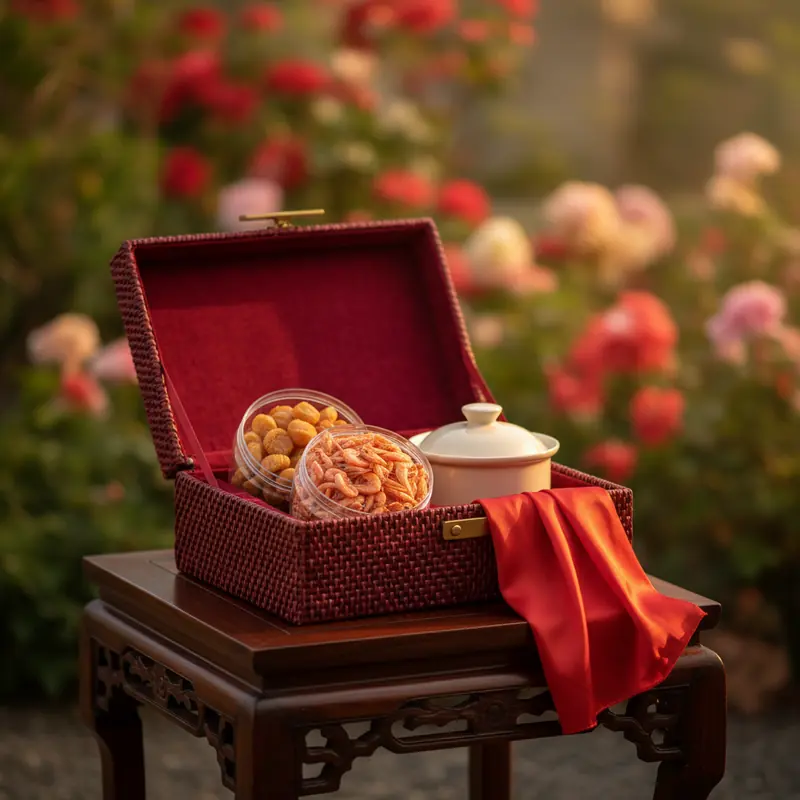
How to reconcile two family betrothal gift lists: preserve the originals
Create one working document with a column for each family’s exact wording. Keep Chinese characters, English descriptions and any handwritten annotations together. If an older relative explains an entry verbally, record the explanation alongside it rather than replacing the original phrase. This makes it possible to ask a precise follow-up question later, especially when a short term carries more meaning for one household than the other.
Add a separate column for the proposed plain-language meaning. For example, write ‘physical dried-food gift, contents not yet agreed’ rather than immediately naming a particular package. Keep the interpretation provisional until the person who supplied the requirement confirms it. A translation can help people discuss an entry, but it should not quietly become the final shopping instruction.
Seafood can be one part of the food gifts discussed for the ceremony, rather than a description of everything needed. The linked Chinese betrothal gifts page concerns dried seafood options; it is not a promise that a complete collection of ritual supplies is included. Use that distinction when deciding which entries belong in a seafood enquiry and which require a separate family decision.
Give every entry a category before deciding whether it matches
Assign each entry to a practical category: physical seafood or related dried ingredients; seafood money; fresh fruit; dried fruit and nuts or other specified dried goods; or a separate wedding present. Add an ‘unclear’ category rather than forcing an unfamiliar phrase into the nearest English translation. The point is to distinguish what will be given, not to standardise the family’s vocabulary.
There is a useful reason for keeping these categories apart. Kee Wah’s Chinese betrothal guide lists ‘海味金或海味籃’, a betrothal fresh-fruit basket, and ‘四京果’ separately. Its presentation supports asking different questions about each entry; it does not establish a compulsory list for every Hong Kong household.
Next, mark the intended role: a gift presented to the receiving family, something intended for return gifting, or another wedding occasion. Two entries may describe the same food but serve different purposes. Do not delete one as a duplicate until you know whether both refer to the same presentation and the same recipient.
Use three matching states, not a forced yes-or-no answer
Label a pair of entries ‘confirmed same item’ only when both families agree on its meaning, form and purpose. Use ‘different items’ when the distinction is clear, such as fresh fruit and a separately requested dried-fruit selection. Use ‘awaiting family confirmation’ when the names appear related but the actual contents or intended substitution remain uncertain.
Consider this hypothetical example: Family A writes ‘生果’, while Family B writes ‘fruit trays’. These could refer to the same requirement, but the wording alone does not establish the varieties, number of pieces or number of trays. Keep the match pending while asking whether both mean fresh fruit for the betrothal ceremony. Once that is agreed, quantity and presentation can be settled without guessing.
Record the question that would resolve each pending entry. ‘Please clarify fruit’ is vague; ‘Does this mean fresh fruit for this ceremony, and is the dried-fruit request additional?’ is answerable. Keeping a short question beside the original wording prevents the same uncertainty from resurfacing when someone reviews the quotation.
Check whether seafood money replaces a physical gift
Treat 海味金 and a physical seafood hamper as different forms until the families explicitly agree otherwise. A reference to seafood money is not an instruction to order a basket as well. Equally, seeing a money option in a guide does not authorise you to replace a physical gift requested by the receiving family.
Chow Sang Sang’s Guo Da Li guide distinguishes dried seafood from a simplified, labelled dried-seafood-money form. Kee Wah’s guide also describes identifying the gifts represented by a substitute red packet. These are useful prompts for a family conversation, not a basis for choosing an amount or a substitute without agreement.
Write down exactly what the substitute covers
A helpful confirmation reads: ‘Seafood money will replace the physical seafood gift for this ceremony; fresh fruit remains a separate requirement.’ This is an example of wording, not a recommended arrangement. Record who approved the substitution on each side and whether any part of the physical gift remains. Avoid a broad note such as ‘all simplified’, which could unintentionally remove something the other household still expects.
Translate seafood descriptions into identifiable products and units
For dried seafood names on a betrothal gift list, separate the family’s category name from the merchant’s actual product description. Ask for the proposed item name, its dried or other supplied form, the number of packs and the stated weight of each pack. If the family specifies a particular ingredient, keep that requirement visible rather than accepting a broad ‘seafood selection’ description as confirmation.
Type counts and physical quantities are different fields. Chow Sang Sang describes seafood sets in terms of four, six or eight types; Hang Heung’s checklist likewise uses ‘四式/六式/八式’. A request for types therefore should not be converted into an equivalent number of loose pieces, jars or packets. Ask the family what selection they mean, then ask the merchant to state how each item is packed.
Once physical seafood is agreed, Wedding dried seafood hampers can provide a starting point for discussing containers and arrangement. Compare a proposed option against your item-by-item list, including pack weights and written contents. A package name cannot confirm compliance with either family’s requirements, and a broad seafood-gift category should not be treated as proof that every included dried ingredient is seafood.
Keep fresh fruit, dried fruit and nuts on separate lines
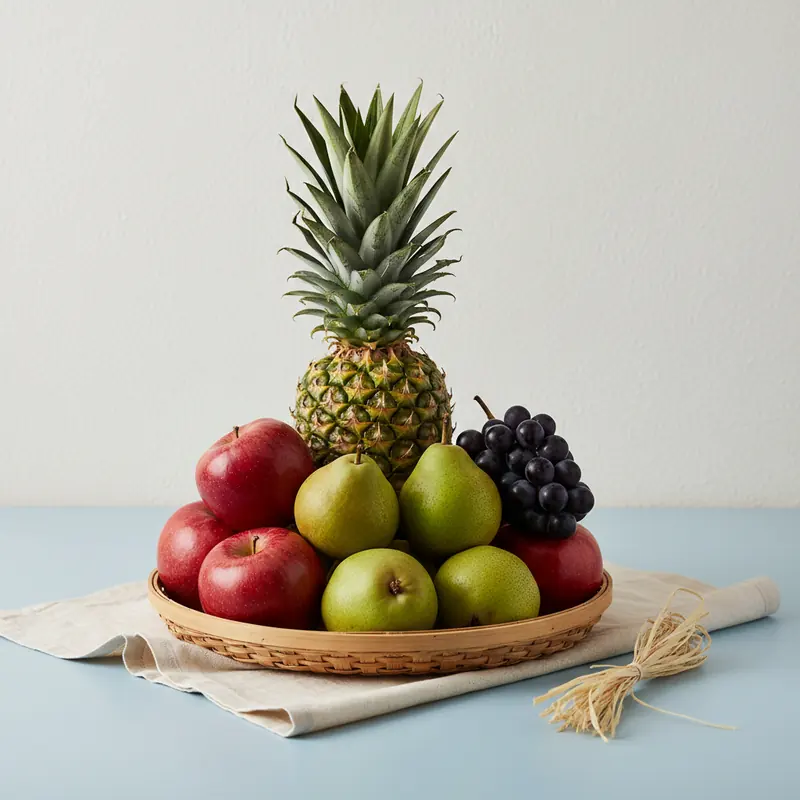
The distinction between fresh fruit versus dried fruit in betrothal gifts is not just a translation detail. ‘Fruit’ in an English message can conceal two different requests. Ask whether the family means fresh produce, specified dried fruit and nuts, or both. A fresh-fruit basket does not settle a separate 京果 entry simply because both descriptions contain the word fruit.
Kee Wah’s Chinese guide names dried longan, dried lychee, dried walnuts and peanuts in the shell under ‘四京果’. Hang Heung uses the different heading ‘八樣京果’. Those published expressions should not be merged into one assumed standard. If the families use these different terms, obtain their intended contents before deciding whether the requests overlap.
Broader Wedding fruit presentation ideas may help when the intended occasion is still being discussed. First establish whether the fruit is for this betrothal ceremony or another wedding-related presentation. That page is not a substitute source for confirming dried-fruit or nut requirements, and a general wedding-fruit description does not define the contents needed for your particular ceremony.

Confirm fresh-fruit varieties, piece counts and presentation separately
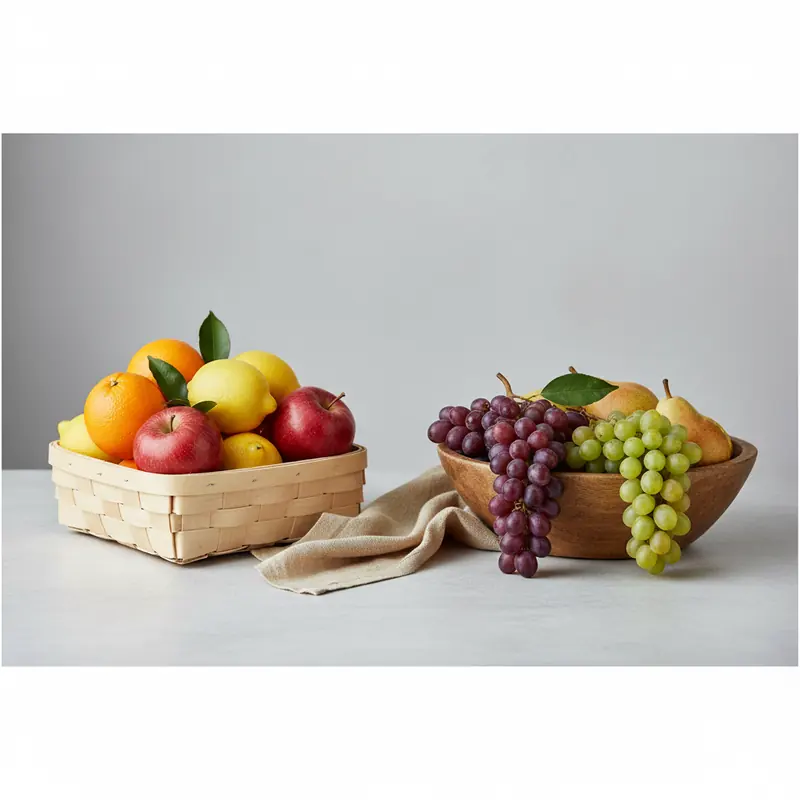
Once both families confirm fresh fruit is required, ask for the actual varieties they agree to receive. Then record the number of pieces of each variety and the number of baskets or trays. These answer different questions: a container count describes presentation, while the item counts describe the food. Do not expect a supplier to infer one from the other.
For the ceremony-specific enquiry, use Betrothal fruit with the family-approved varieties, piece counts and basket or tray requirements. A reference image can help explain whether you mean separate trays or a combined basket, but it does not establish fixed contents. If the pictured fruit differs from the approved list, ask about that difference rather than silently accepting the photograph as the order.
If availability creates a proposed change, return the exact alternative to the families for approval. Do not publish or rely on a universal list of suitable or unsuitable fruit to resolve a family disagreement. The useful question is narrower: ‘Would this specific alternative meet the requirement you gave us?’ Until answered, keep that line pending.

Build a crosswalk that a family member and a merchant can both read
Give every requirement a simple row reference and retain it throughout the conversation. Each row should contain both original phrases, the agreed category, the intended contents, the unit of quantity, the ceremony purpose, any return-gift instruction, the matching state and the people confirming it. Use ‘not yet specified’ where information is missing; a blank space can look like permission for someone else to decide.
Here is a hypothetical row in plain language: ‘Fruit row: Family A says 生果; Family B says fresh-fruit trays; category confirmed as fresh fruit for Guo Da Li; varieties and piece counts awaiting agreement; container format under discussion; return-gift arrangement not yet decided.’ This is useful even before it is complete because it exposes exactly what remains unresolved.
Keep merchant wording in its own field when a quotation arrives. That allows you to compare a proposed product against the approved family requirement without erasing the latter. If the merchant writes only ‘ceremony fruit set’, request the underlying contents and quantities; do not copy that phrase into every empty field and call the reconciliation finished.
Decide presentation and return gifting without changing the requirements
Once the contents are understood, discuss how they need to be presented and divided. Ask whether items should be accessible separately, grouped by type, or kept together in a display. This is where a basket or tray design becomes useful: it helps communicate handling and arrangement rather than deciding which gifts count as fulfilled.
Keep return-gift instructions explicit. Do not assume that a published custom about returning part of a gift is the rule for both households, or that every category will be handled in the same way. Ask what, if anything, the receiving family intends to return, and whether that changes the requested packaging.
Distinguish repacking from adding another gift
If a family asks for ‘another basket’, clarify whether they mean an extra container for the already agreed contents or an additional gift with additional contents. These are different ordering instructions. Record the answer before requesting a revised quotation, particularly if someone else is coordinating the fresh fruit while you handle the seafood.
Keep an ordinary wedding present outside the ceremony list
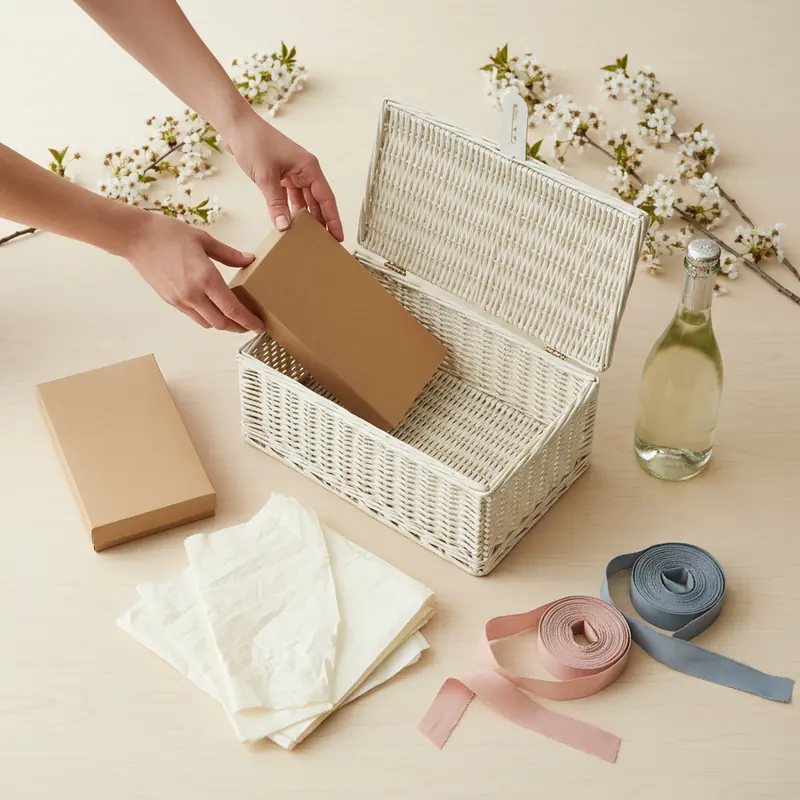
A relative may also want to send the couple a separate gift for their wedding. Keep that request on a separate line with its own recipient and occasion. A thoughtful personal hamper may be welcome as a distinct present, but its existence does not automatically fulfil a seafood, fresh-fruit or dried-goods requirement agreed for Guo Da Li.
If you are also choosing that separate present, the Wedding gift hamper customisation guide can help organise preferences for a general hamper. Its role here is limited to the additional wedding gift. Do not treat a preference-led assortment as an approved substitute for ceremony gifts or assume the guide offers a complete betrothal package.
This separation also prevents duplicate enquiries. Tell each person arranging a gift whether their brief is ceremonial or personal, and give one coordinator responsibility for the joint ceremony list. Two people can otherwise both order ‘the wedding basket’ while believing they are handling different requests.
Resolve family questions before asking the merchant to finalise
Send unresolved rows to the relevant family members as short, specific questions. Ask the merchant factual product questions instead: what is included, what a label means, what quantities are proposed, and whether a requested arrangement can be discussed. A supplier can describe a product, but cannot decide that one family’s custom overrides the other’s wording.
Where the same phrase means different things to the families, state the difference neutrally. For example: ‘One list appears to request dried fruit and nuts; the other mentions fresh fruit only. Shall we retain both categories, or was one intended to replace the other?’ This is a hypothetical prompt, not evidence of any particular family practice. It invites a decision without suggesting that a relative’s list is wrong.
Keep one approved version of the joint list and make later changes visible. If a substitution is accepted, record the old requirement, the replacement and the people who agreed. If the answer remains uncertain, ask whether a provisional enquiry excluding that unresolved line would be useful; do not label the whole ceremony order final merely to obtain a package quotation.
Compare the written proposal with the approved list before ordering
Read the proposed order line by line against the joint list. Look for an omitted dried-goods category, a money substitute that has accidentally become an additional physical gift, fruit described only by container count, or seafood described only by the number of types. Ask for discrepancies to be corrected in writing so that the approved version and the merchant’s version tell the same story.
Confirm the current price, any delivery charge, the requested receiving date and the feasible arrangements with customer service for your individual order. Also establish what happens if the proposed contents need to change before preparation or dispatch. No illustration, older product description or family discussion confirms current availability or a delivery promise.
Your final handover should be concise: the approved contents, clearly stated units, agreed packaging, any separate return-gift instructions, and the scope of any money substitute. Keep the originals attached for context, but make it clear which version is approved for ordering. The aim is not to make both families use identical words; it is to ensure that everyone understands the same gifts.

Details to confirm before ordering
- List version: [reference]; original wording from both families retained: [yes / outstanding entries].
- Matching status: confirmed same items [ ]; different items retained [ ]; unresolved rows [ ].
- Seafood form: [physical gift / agreed money substitute]; replacement scope [ ]; family approvers [ ].
- Physical seafood or related dried ingredients: item names [ ]; supplied form [ ]; pack counts and stated weights [ ].
- Fresh fruit: agreed varieties [ ]; pieces of each [ ]; baskets or trays [ ]; dried fruit and nuts recorded separately [ ].
- Presentation and return gifting: agreed grouping [ ]; items to be returned, if any [ ]; extra container or extra contents clarified [ ].
- Written proposal: contents match approved list [ ]; current price and delivery charge confirmed [ ]; receiving date and change arrangements confirmed [ ].
Questions about this decision
Can I merge two entries because both translate as fruit?
Not on translation alone. Confirm whether each means fresh fruit, dried fruit and nuts, or another specified selection. Mark them as the same item only after both families agree on contents, purpose and quantity.
Should four types of seafood be ordered as four packets?
A type count does not specify packet count or weight. Record the agreed item names first, then obtain the pack quantity and stated weight for each item in the merchant’s proposal.
Are 四京果 and 八樣京果 interchangeable names?
Do not assume so. The supplied guides use different expressions, and a family’s intended contents still need to be identified. Keep the entry awaiting confirmation until you have the actual list from the relevant family members.
Who should decide whether seafood money is acceptable?
The families should agree whether it replaces the physical seafood gift and exactly what it covers. A merchant can clarify a proposed product but should not be asked to approve a family custom on their behalf.
What if a quotation uses only a package name?
Ask for the actual contents, pack sizes or piece counts and packaging details. Compare those details with the approved joint list before confirming; a package name or photograph does not resolve missing requirements.
Sources and further reading
Reference only. Illustrations are AI-generated design references, not photographs of actual customer orders. Confirm current contents, prices and arrangements with our team.
For this guide:Different Names on Your Families’ Betrothal Lists? Match the Seafood and Fruit Before Ordering
Arrange a thoughtful gift
Considering Chinese betrothal gifts? Send the date, district and the points discussed in this guide to YumYum Gifts to confirm suitable options and a quotation.
Order Your GiftWhatsAppThis opens a prepared WhatsApp enquiry. Availability, details and price must be confirmed before booking.
Explore related services and designs
Compare relevant options, view design references and find the information you need before making an enquiry.
Gift basket delivery
Compare gift basket formats and the delivery details to discuss, including recipient arrangements and presentation, without assuming that any particular delivery timing is available.
Wedding dried seafood hampers
Compare dried seafood hamper presentation for Chinese betrothal gifting, including container styles and arrangement directions, while discussing the specific contents and family expectations separately.

Wine hamper
Compare wine hamper layouts, bottle presentation and accompanying gift directions for adult recipients, considering their preferences before deciding which combination to enquire about further.
Wedding gift hamper
Compare personalised hamper combinations, including wedding gift directions, by looking at contents, container styles and finishing touches that can be discussed around the recipient's preferences.
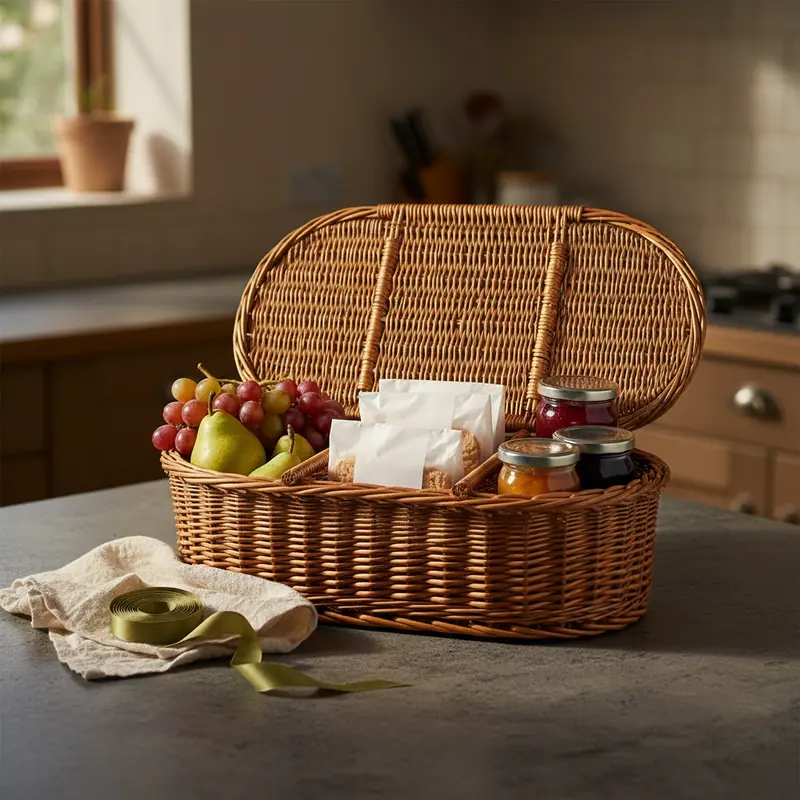
Gift hamper
Compare fruit and gourmet hamper directions, basket presentation and recipient preferences to narrow down a gift composition before discussing the contents that matter to you.
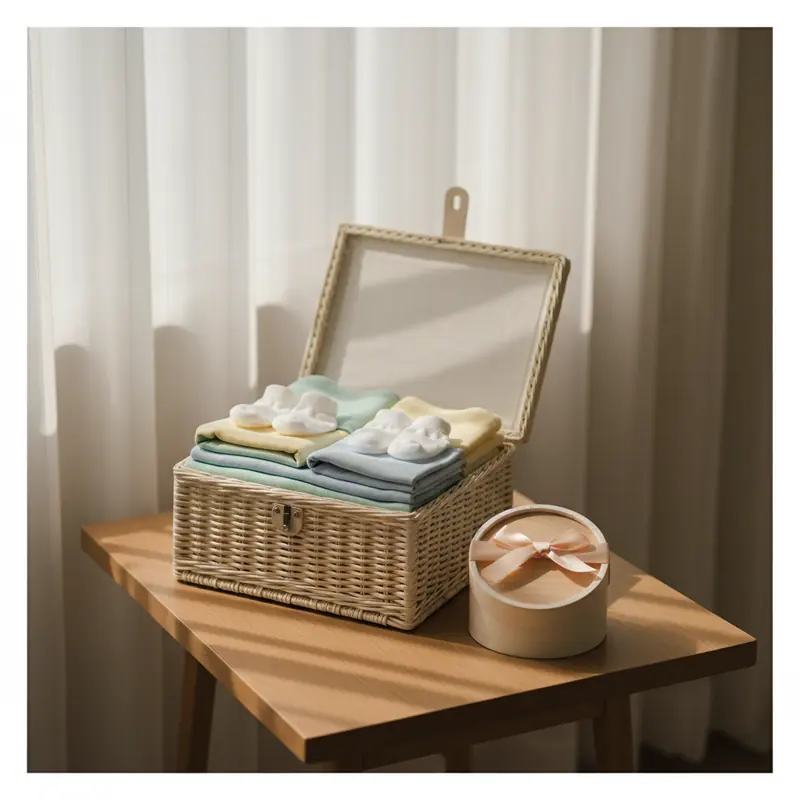
Full moon gift sets
Compare newborn hamper and full moon gift presentation, looking at keepsake and textile combinations while keeping the family's preferences and the baby's needs in view.
Original AI-generated navigation references; designs and order details are subject to confirmation.
Useful options for your plans
Check Gift hamper delivery in Hong Kong when considering how your chosen basket will reach its recipient.
Explore Chinese betrothal gifts to compare dried seafood presentation for your betrothal arrangements.
Explore Bespoke gift hampers to compare personalised combinations, including a wedding gift direction.
Compare Wine hamper presentation for an adult recipient who enjoys wine.