Y. Florist · Ordering guides
One Funeral Tribute from Several Relatives: Agreeing the Message and Display Size
For this guide:One Funeral Tribute from Several Relatives: Agreeing the Message and Display Size
Arrange your flower order
Considering condolence flowers? Send the date, district and the points discussed in this guide to Y. Florist to confirm suitable options and a quotation.
Order Your FlowersWhatsAppThis opens a prepared WhatsApp enquiry. Availability, details and price must be confirmed before booking.
When several relatives send one funeral tribute, the difficult decision is often not which flowers to choose. It is how to represent everyone accurately without turning a short inscription into a family directory, and how to agree a display that fits the venue rather than the number of contributors. A joint family condolence flower order needs one clear set of instructions, not several overlapping conversations.
Start by asking the organising family whether flowers are welcome and where a shared tribute could be placed. Then use the steps below to settle representation, wording and dimensions before making a purchase. The aim is a modest piece of coordination: one contact, one approved message and one practical display specification. These are suggested family arrangements, not a claim that a florist offers group payment, proofreading or a particular approval service.
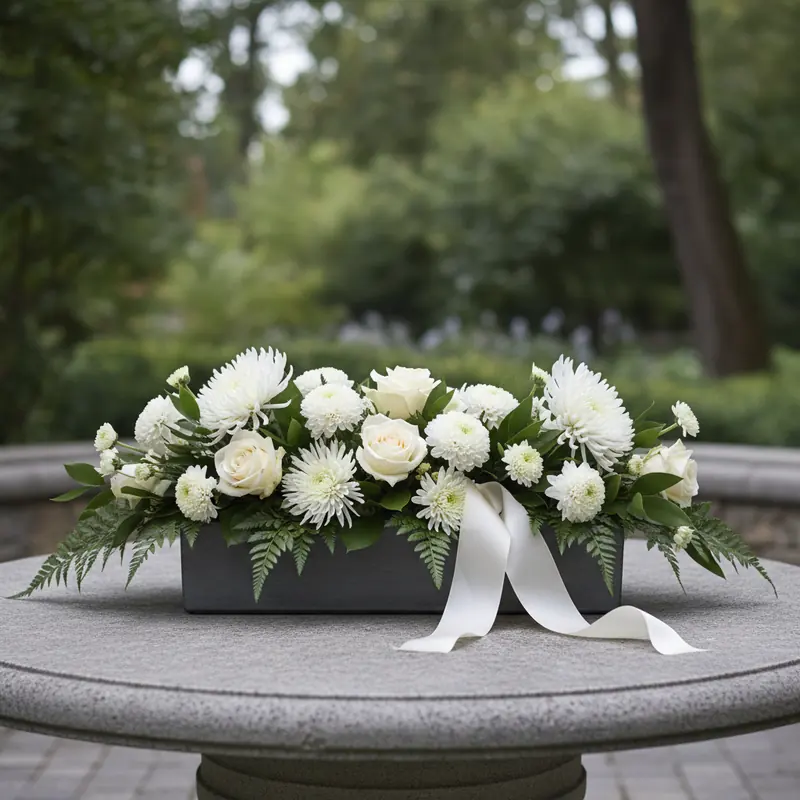
Start with the family's wishes and the intended setting
Ask the person organising the service whether the family would welcome one tribute from the relatives concerned. Check whether it should go to the ceremony venue or another agreed location, and whether a particular display area has been identified. This avoids asking everyone to approve an arrangement that the organising family cannot accommodate. Keep the question specific and easy to answer: is a shared floral tribute welcome, and who can confirm its placement?
Once that is clear, compare suitable forms of condolence flowers with the setting in mind. A basket, a standing piece and a wreath make different demands on the available space; none should be chosen solely because many relatives are contributing. Faful Florist's Hong Kong funeral-flower guide discusses collective tributes and distinguishes standing arrangements from baskets for smaller settings. Use that distinction as a starting point for questions, not a rule that overrides the family's wishes.
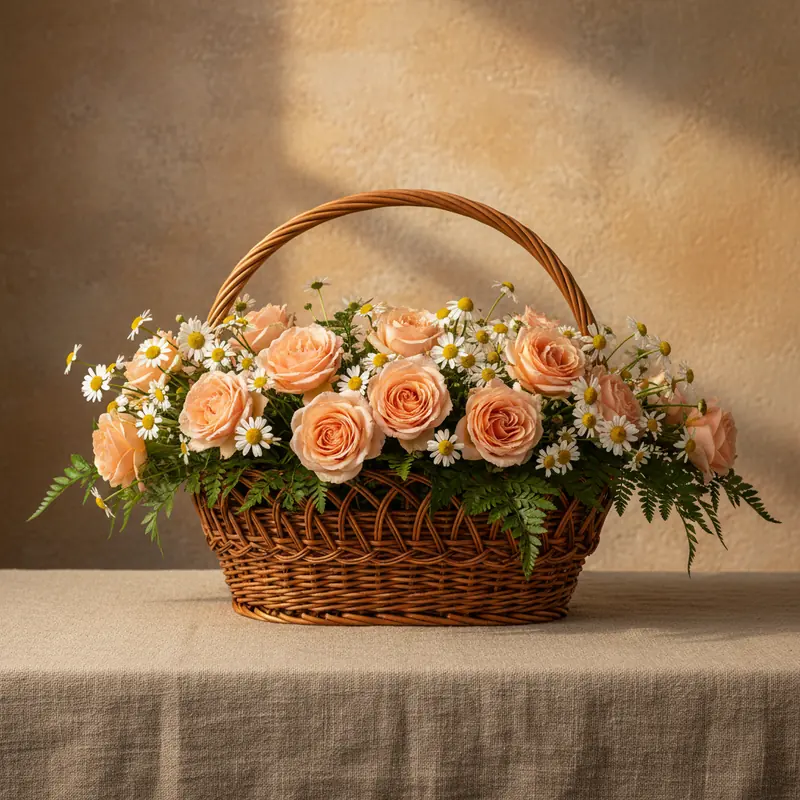
Give one contact a clearly limited role
Choose one relative to collect decisions and communicate with the florist. Being the contact does not automatically give that person permission to alter names, select religious wording or spend beyond the family's agreed budget. Decide separately who may approve the final wording and order details. The contact and final approver can be the same person, provided the participating relatives understand and accept that arrangement.
Keep contributions and reimbursement within a separate family conversation. The inscription should not become a record of who paid more, and the contact should not assume that a shop can divide one order among several payers. If payment arrangements matter, ask what is possible before proceeding. When relatives have different preferences, the contact's task is to return one clear question to the group rather than forward every competing message to the florist.
- Family contact: [name or agreed identifier].
- Person authorised to approve the final order: [name or agreed identifier].
- Decisions needing further family agreement: [wording, sender list, size or other detail].
Define whose names the tribute represents
Before drafting a sender line, make a private working list of the participating relatives. Record each person's preferred written name, their relationship to the deceased if it may appear, and whether they are speaking only for themselves or for an agreed family branch. A surname alone does not establish that everyone in that household or branch has agreed to be included. Ask rather than infer.
Let each branch check its own entry and ask whether any participant has been omitted. Resolve preferred spelling and the order of names before discussing layout. If the family wants a particular order, record it explicitly instead of expecting the florist to reconstruct relationships from a chat. Contribution amounts are not a useful basis for deciding the public order of relatives' names.
Choose individual names or an agreed collective signature
Individual names make participation explicit but need more space. A collective signature can be shorter, but only works if the people it appears to represent have accepted it. In a hypothetical example, cousins from different households might agree to sign as a named group of cousins rather than list every partner and child. That wording would still need their approval; it is not a standard formula or permission to include absent relatives automatically.
Keep the addressee, message and sender line separate
Create three distinct text fields: the person being addressed or commemorated, the short tribute message, and the sender line. This makes errors easier to spot. A relative can then check the deceased's name without accidentally approving an unfinished list of senders. Also distinguish a tribute addressed to the deceased from a condolence message addressed to the bereaved family; do not leave the intended recipient for the florist to guess.
Relationships need particular care when several generations are involved. One person's aunt may be another person's grandmother, so a single relationship term may not represent everyone accurately. U Flower Shop's guide to funeral-wreath inscriptions includes relationship-specific and multigenerational sender examples. It illustrates why relationships matter, but its examples are not compulsory wording for every Hong Kong family. Ask the organising family to confirm any uncertain title or relationship description.
Agree a short message before discussing decoration
A funeral flower message from multiple relatives does not need to combine a separate sentence from every contributor. Ask everyone to approve one shared sentiment, while keeping personal memories for a separate note if they wish. For example, a family might consider 'Remembered with love by all of us' as a starting point. This is an illustrative English phrase, not a prescribed inscription or a substitute for checking the family's preferred tone.
When the group includes different relationships or needs Chinese and English wording, have the designated contact ask a Hong Kong florist whether wording and presentation assistance is available. Explain which parts the family has already approved and which remain questions. Do not assume the shop can verify kinship, translate a formal inscription or provide a proof. Those arrangements need to be discussed, while the family remains responsible for confirming whom the wording represents.
Approve each language version on its own
For bilingual text, keep separate fields for each language and ask someone trusted by the family to check both. Confirm whether personal names should appear in one language or both, and whether the two versions convey the intended relationship and tone. Do not treat an automatic translation as family approval. If religious language is proposed, ask the organising family whether it fits this particular service rather than assuming it from a surname or venue.
Check the actual writing space before shortening names
Once the message and sender list are drafted, ask what writing surface accompanies the proposed arrangement: a ribbon, a card or another format. Request the available space and any practical text restrictions for that specific design. Funeral Partners notes that flower cards can leave little room for lengthy messages. That supports checking the layout early; it does not establish a universal word limit for Hong Kong ribbons or cards.
If the wording does not fit, take the problem back to the relatives in a sensible order. First consider shortening the shared message, then review whether the approved sender line could use a collective form. Do not silently remove a name or shrink the text until it becomes difficult to read. Ask whether another presentation is available and what it would involve. Any revised wording should return to the family as a complete replacement version, not as a verbal instruction to 'make it shorter'.
Compare display forms without using headcount as a size rule
Separate the question 'Does this represent us?' from 'Will this fit?' A larger group can send a restrained arrangement, and a smaller group may choose a more prominent piece if the family welcomes it and the space permits. Neither choice measures affection. Decide what the display needs to do in its agreed position: stand on the floor, rest on an approved surface or occupy another confirmed location.
Compare only options that can work there. A basket may require a surface or a specific floor position; a standing arrangement requires room for its support; a wreath's outline does not tell you its total footprint. Shape and height illustrations can help the relatives describe their preference, but they are not measurements. Ask the florist about the actual proposed item rather than treating a reference image as a complete specification or an available funeral product.
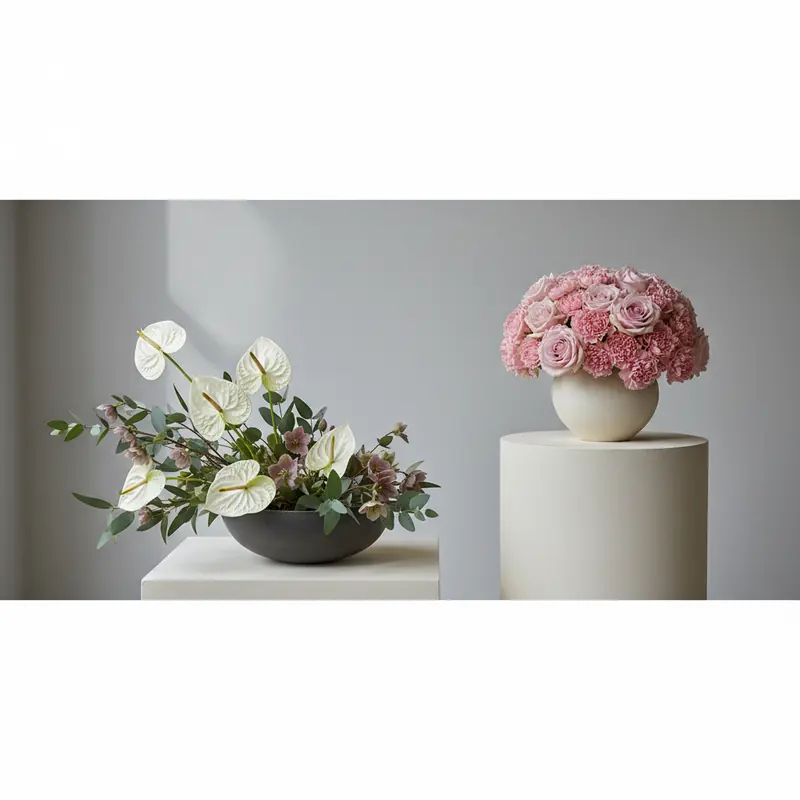
Ask the venue about the whole space, not just a gap
Send the proposed location and display form to the venue contact who can confirm placement. Ask what space is available for the entire arrangement, including its container or support. A low arrangement and a tall piece can occupy similar floor areas yet sit very differently beside other tributes. Check whether an existing table is actually available before choosing a design that depends on one.
Request any relevant restrictions on height, width, access and positioning. Describe the intended place clearly enough that the venue and florist are discussing the same area, rather than simply recording 'near the entrance'. If placement has not been confirmed, mark it as unresolved in the family summary. It is better to pause the size decision than have relatives approve a design on the mistaken assumption that someone else has checked the space.

Record the floral face, overall height and base separately
A label such as 'large' is not enough for a shared approval. Ask for the floral face's width and height, the total display height including its support, and the base footprint. Record the units used, whether measurements are approximate and whether the stand is included in the proposed arrangement. These are different details: the visible flowers may fit within the chosen area while the support extends beyond it.
If the family already prefers a circular tribute, use the funeral wreath page to enquire about actual designs and dimensions. The funeral wreath size for a shared family tribute should follow the confirmed location and available specification, not the number of households sharing the cost. Ask the venue to review the same measurements the florist supplied, and keep its response with the order summary.
Use a dimension record that leaves no hidden assumptions
Keep separate entries for floral face width and height, overall height with support, base width and depth, and stand inclusion. Where the florist cannot yet confirm a detail, write 'awaiting confirmation' rather than filling the gap from the picture. If the design changes, ask which measurements change with it. This gives the authorised relative something concrete to approve without inventing a standard size chart.
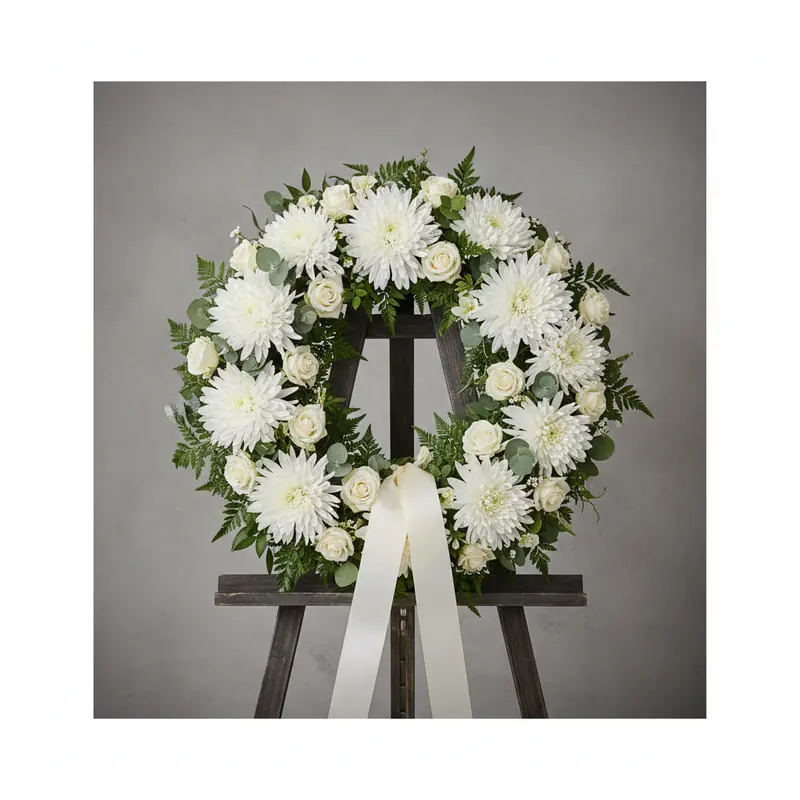
Review one complete version, not scattered corrections
Bring the approved representation, inscription and dimensions together in a single document or message. Give it a simple version label such as 'Family review A', so replies can refer to an identifiable draft. Ask relatives to check the complete sender line even if they previously supplied their own names. Collecting correct individual entries is useful, but it does not prove that the assembled list is complete or that its sequence is agreed.
If someone spots an error, replace the whole affected text field in the next version. A correction such as 'change the second name' can become ambiguous after another edit. Once the authorised relative approves the complete version, the contact should send that version to the florist and ask which details can be confirmed. If a proof is offered, establish what it covers and how revisions work; do not assume that a family chat is a shop's production approval.
Agree the boundaries for substitutions and later changes
Before committing, ask about current flower and material availability for the proposed design. Separate flexible preferences from details that need another family decision. The group might be open to a different flower while still requiring the agreed overall shape, sender wording and venue-compatible dimensions. Describe those boundaries in ordinary language, and ask what the florist can accept. A design illustration does not promise particular stems, quantities or accessories.
Also ask what happens if a requested material is unavailable or a relative seeks a later change. Who should be contacted, what needs renewed approval, and could the change affect the cost, dimensions or handover? Let one authorised person respond rather than invite conflicting instructions. Do not invent a universal amendment deadline: ask about the conditions for this order and share the answer with the relatives before they treat the details as settled.
Complete the shared order summary before purchasing
The final summary should connect the words to the physical tribute: agreed sender representation, exact inscription, chosen format, confirmed dimensions, placement information and permitted substitutions. Add the service date, venue and hall details where applicable, together with an agreed handover contact. Share personal contact details privately with the people who need them rather than circulating unnecessary information across a large family group.
With that summary ready, you can order flowers online after checking availability, the full charge, stand inclusion, amendment conditions and the proposed delivery or collection arrangement with customer service. Confirm who may receive the tribute and whether any venue instructions still need to be passed on. This is one order represented by an authorised contact; it does not imply a shared checkout facility. If wording or placement remains unresolved, ask what can be held for discussion rather than submit a guess.
Details to confirm before ordering
- Family wishes and placement: flowers welcomed, intended location identified and venue contact consulted.
- Representation: participating individuals or family branches recorded, with permission for the exact sender line.
- Wording: addressee or commemorated person, short message, relationships and each language version checked separately.
- Authority: one contact and one final approver agreed; the complete approved version clearly identified.
- Physical specification: floral face, total height with support, base footprint, units and stand inclusion confirmed.
- Order conditions: actual availability, full charge, acceptable substitutions and amendment arrangements checked with customer service.
- Handover: date, district, venue and hall details where applicable, plus an agreed receiving contact and confirmed delivery or collection arrangement.
Questions about this decision
Must every relative's name appear on a shared tribute?
Not necessarily. The participating relatives can agree an accurate collective signature instead of individual names. Confirm exactly whom it represents and obtain their agreement; do not use a broad family label simply because the full list is inconvenient.
What if relatives have different relationships to the deceased?
Avoid a single relationship term that only fits some senders. Keep the relationships in the private working list, then ask the organising family to approve either separate descriptions or a neutral collective sender line.
Should more contributing households mean a larger wreath?
No. Choose dimensions against the agreed placement and the florist's actual specification. The floral face, support height and base footprint matter more to fit than the number of contributors.
Can the family approve the text before a layout is available?
You can agree the wording first, but still ask whether it fits the proposed card or ribbon. If a layout requires changes, return the complete revised text to the authorised relative. Ask whether the florist offers a proof and what its approval process covers.
What should happen if another relative wants to join after approval?
Ask the florist whether an amendment is still possible and whether it affects the layout or charge. Obtain agreement to the revised sender line, then have the designated contact submit one complete replacement version. Do not assume a late addition can be accommodated.
Sources and further reading
Reference only. Illustrations are AI-generated design references, not photographs of actual customer orders. Confirm current contents, prices and arrangements with our team.
For this guide:One Funeral Tribute from Several Relatives: Agreeing the Message and Display Size
Arrange your flower order
Considering condolence flowers? Send the date, district and the points discussed in this guide to Y. Florist to confirm suitable options and a quotation.
Order Your FlowersWhatsAppThis opens a prepared WhatsApp enquiry. Availability, details and price must be confirmed before booking.
Explore related services and designs
Compare relevant options, view design references and find the information you need before making an enquiry.
funeral wreath
Compare funeral wreath shapes, flower choices and overall scale, considering ribbon preferences and the venue arrangements to discuss before selecting a respectful memorial floral design.
condolence flowers
Compare restrained condolence floral styles, arrangement scale and ribbon options, considering the memorial setting and venue handover details while keeping the presentation respectful and appropriate.
Original AI-generated navigation references; designs and order details are subject to confirmation.
Useful options for your plans
Explore a funeral wreath to compare shape, flower choices and scale for a respectful memorial presentation.
Compare condolence flowers by restrained floral style, scale and ribbon options for the memorial setting.