Y. Florist · Ordering guides
One Flower Order for Several Branch Openings: Which Site Specifications Must Stay Separate?
For this guide:One Flower Order for Several Branch Openings: Which Site Specifications Must Stay Separate?
Arrange your flower order
Considering grand opening flower basket? Send the date, district and the points discussed in this guide to Y. Florist to confirm suitable options and a quotation.
Order Your FlowersWhatsAppThis opens a prepared WhatsApp enquiry. Availability, details and price must be confirmed before booking.
A flower order for multiple branch openings needs two layers of information: one shared design brief and a separate record for every display at every site. A consistent colour direction can connect the openings visually; it cannot tell the florist whether a particular entrance has room for a stand, whether a counter needs a low arrangement, or who has approved the message for that branch.
Start by giving each branch a short code, then identify its entrance, reception and ceremony positions. Ask the local team to complete the measurements and access details for those positions before treating a central selection as final. The method below helps you prepare an enquiry without assuming that a single order, combined payment or coordinated arrival schedule has already been accepted.
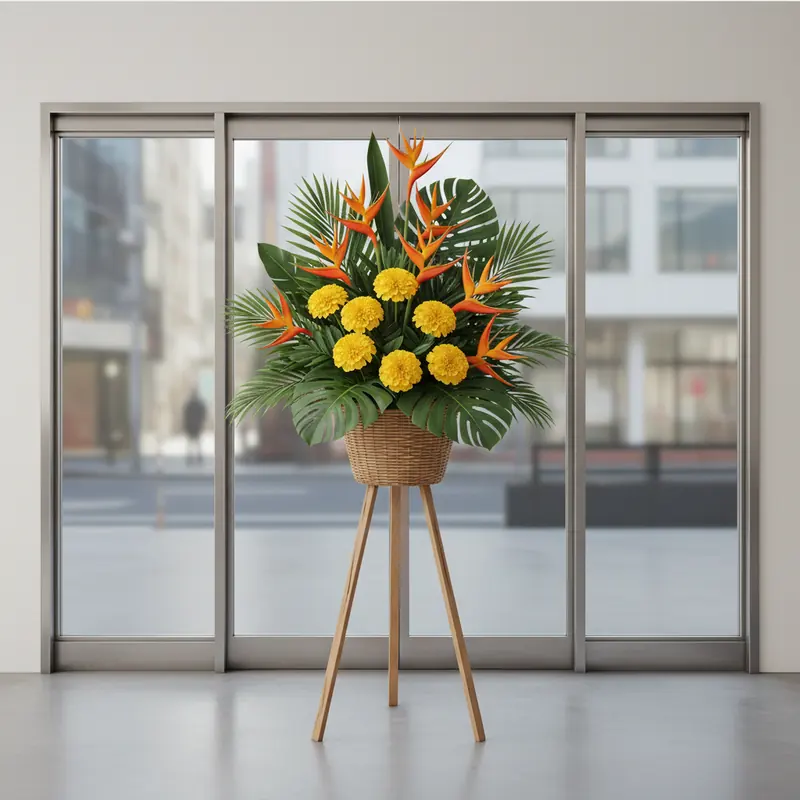
Keep one shared brief for the visual direction
The shared brief should explain what ought to look related across the openings. Record the preferred colour family, the overall style, the prominence of the sender's branding and any reference images. Describe whether the intention is restrained, sculptural or full and celebratory rather than relying on a photograph alone. Identify essential features separately from preferences, so the florist knows which changes need a new discussion.
Add one central design approver and your preferred approach to allocating the budget. For example, head office might wish to prioritise entrance displays while allowing simpler reception pieces; that is an instruction for a quotation, not a confirmed package. State which alternative colours or forms could be considered if a preference is unavailable. Exact flowers, shades, quantities and reproduction of a reference image still need confirmation for the order.
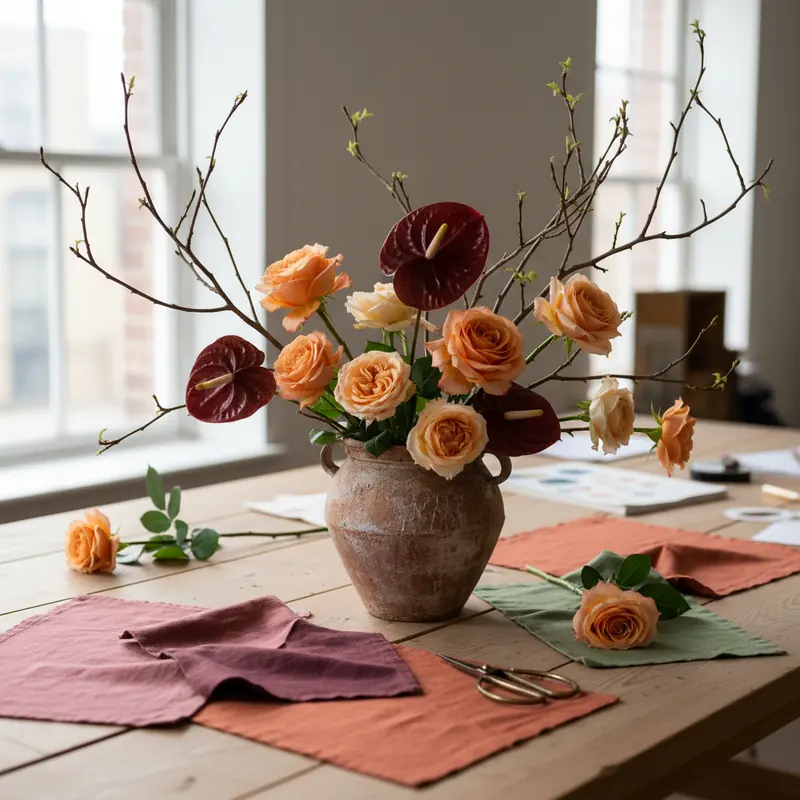
Give every branch and display position its own identity
Use a branch code that stays the same through the enquiry and approval process. Under that code, create a separate position record for each intended display: entrance, reception counter or ceremony area. If one branch has two entrance positions, keep two records rather than describing them as a pair with identical requirements. Their permitted footprints, viewing directions or proximity to doors may differ even within the same shopfront.
For each position, record the proposed floral form, quantity and purpose. An entrance display might welcome arriving guests, while a counter arrangement is intended to sit beside the reception team. This distinction helps you discuss alternatives intelligently: moving an arrangement from the entrance to the counter changes its job as well as its location. Keep cancelled positions visible as cancelled so an older branch list is not mistaken for the current allocation.
Separate branch names, recipient names and message proofs
The company paying for the flowers, the business receiving them and the individual accepting delivery are not necessarily the same name. Keep separate fields for the sender wording, the recipient wording printed on the card or banner, the branch trading name and the on-site receiving contact. Reusing the same sender across the order should not cause every recipient line to be copied from the first branch.
Attach each proof to its branch and position code. If the same message is intended everywhere, check that intention explicitly, including any branch names, language choices and line breaks. For different messages, ask the central approver to review a clearly labelled set rather than an unlabelled sequence of screenshots. A spelling approval should be recorded separately from approval of dimensions, delivery timing or installation scope.
Record entrance dimensions without borrowing another branch's limits
For an entrance position, distinguish the base footprint from the overall floral width, depth and height. Note the door's opening movement, the sign area that should remain visible and the route guests and staff need to use. Ask the venue which placement area is permitted and whether any display restrictions apply. Do not turn a measurement taken at one branch into a standard clearance for every property.
Venue size is a useful reason to compare forms, not just to choose a larger or smaller version of the same display. A Hong Kong opening-flower guide discusses smaller baskets for compact venues and stands for wider frontages. When comparing a grand opening flower basket with a stand for your own branches, provide the measured limits for each position and ask which current options merit consideration. A compact choice for one doorway need not determine the size used elsewhere.
Show the position as well as the space
Attach a reader-supplied photograph or simple sketch with the intended position marked. Label where the width and depth were measured, and note nearby doors, signs and fixed furniture. An unmarked photograph can show the wrong corner or conceal a projecting obstruction. Treat it as supporting context, not a substitute for measurements or evidence that a proposed installation has been approved.
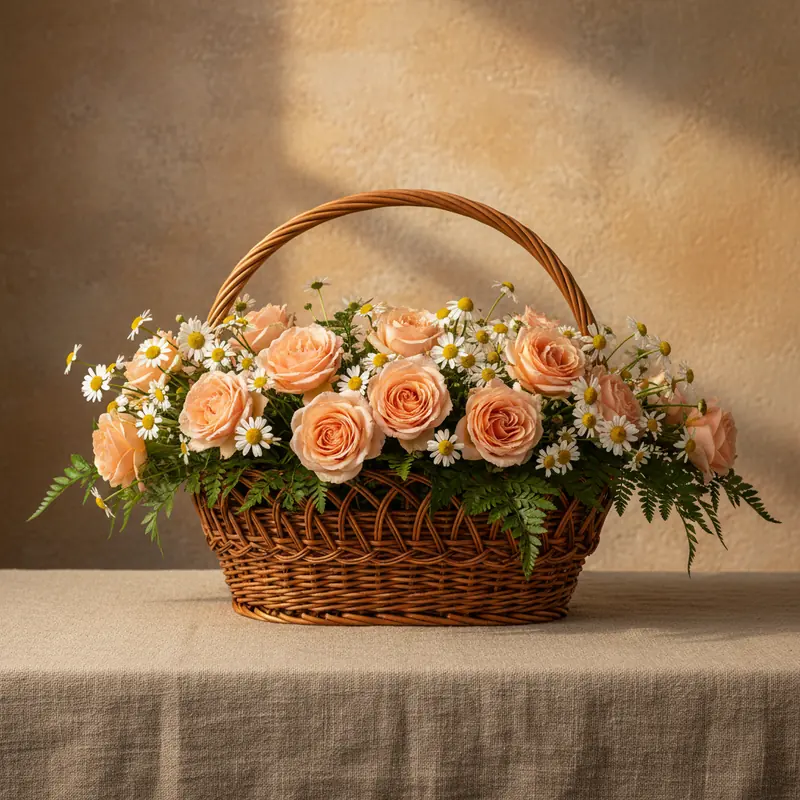
Measure the reception counter as a working surface
A reception counter needs its own record even when it sits a few steps from the entrance. Measure the usable surface rather than the whole countertop: allow for the actual location of payment equipment, paperwork, screens and other items that must remain. Add the counter height and describe whether the arrangement will be viewed mainly from the guest side, the staff side or both.
The same brand palette can work across counters with very different layouts. Before choosing corporate flower arrangements, explain where staff need to see approaching visitors and where guests need to see the receptionist. Ask about a suitable form for that position rather than using the height of another branch's arrangement as the specification. If a counter layout is still changing, mark its dimensions as provisional and assign someone to remeasure it.
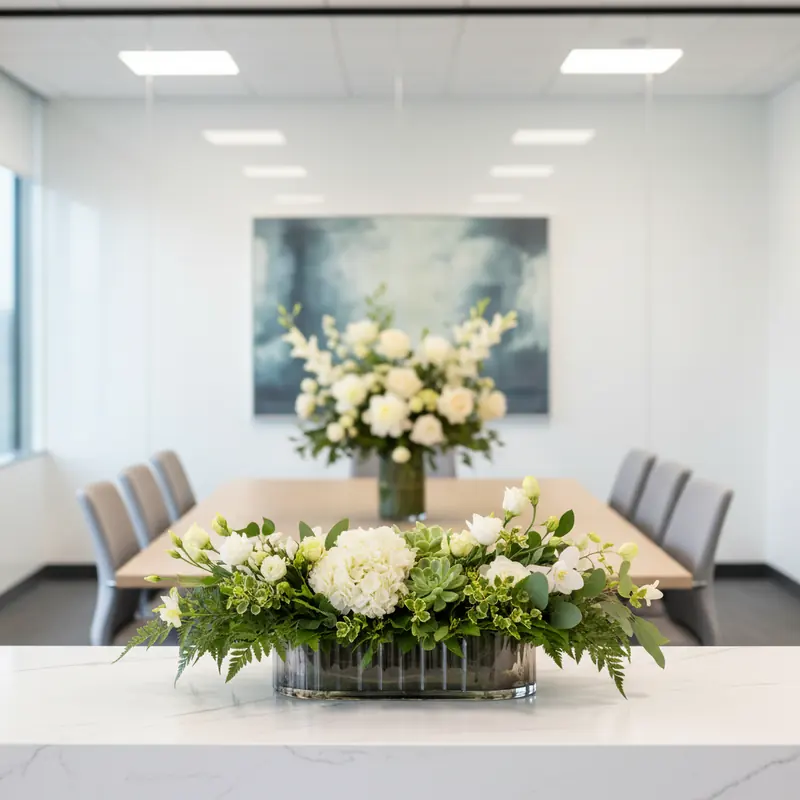
Treat ceremony and backdrop flowers as a separate display brief
For a ribbon-cutting or photo area, record the background dimensions and the direction from which guests and the camera will view it. Mark where people are expected to stand and which text, logo or entrance feature must stay visible. A floral piece that works beside a doorway may not frame the intended photograph, so do not allocate it to the ceremony area simply because it shares the right colours.
Ask the venue about attachment and installation restrictions, and describe whether the proposed location is indoors, exposed to sunlight or affected by wind. These are points for assessment, not a guarantee that a reference installation can be recreated. A corporate-event floral planning guide identifies table dimensions, entrances, stages and guest movement as planning inputs. Use that general framework for your specification; local property conditions still need their own confirmation.
Compare two hypothetical branches without forcing identical sizes
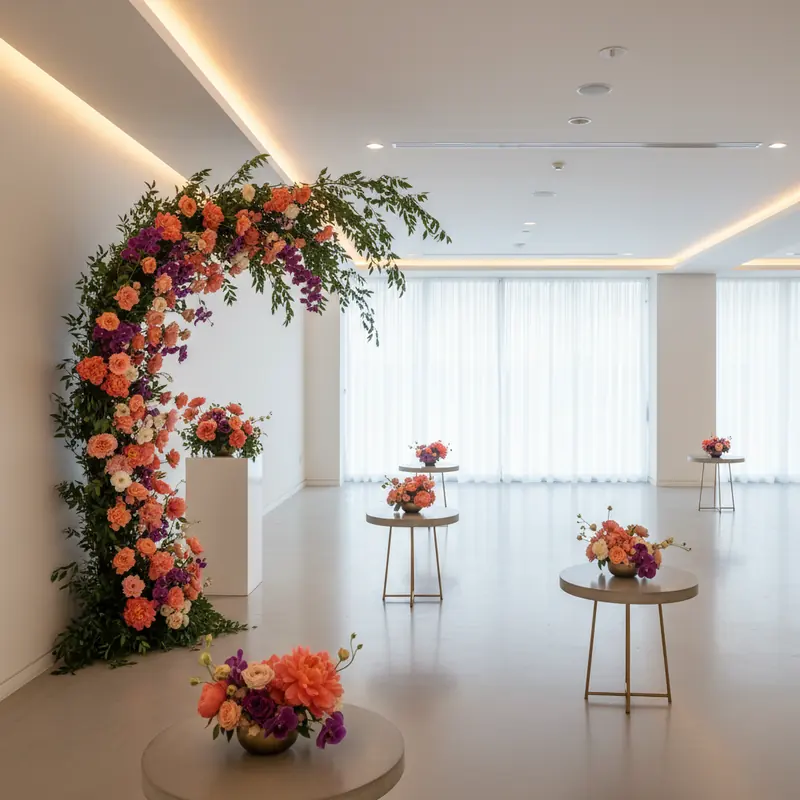
Consider a hypothetical opening programme with a narrow entrance at Branch A and a wider reception area at Branch B. The common brief calls for a warm colour family and a restrained, contemporary outline. Branch A's permitted entrance area may lead you to discuss a compact basket, while Branch B may have room for a larger entrance display and a separate low counter arrangement. These are alternatives to review, not confirmed product recommendations or a real customer example.
If Branch A needs a smaller entrance piece, change that position record alone. Keep Branch B's requirements intact unless its own measurements or priorities change. The visual connection can come from the agreed colour direction and overall character rather than identical dimensions. This also makes the trade-off visible to head office: reducing a footprint to suit a doorway is a local response, not an automatic reduction across the entire opening programme.
Distinguish matching appearance from matching allocation
Ask separately whether the branches should have comparable visual emphasis or the same number of pieces. Those are different requests. One branch might need an entrance focus, while another needs modest flowers at several indoor points. State the priority for each site, then request an itemised proposal that identifies which design and quantity belong to each position. Do not assume equal spend, a cross-branch discount or a standard bundle.

Write access instructions for the actual receiving property
Keep the full delivery address, building name, floor and unit in the relevant branch record, alongside the unloading entrance and any lift or carrying-route restrictions supplied by the venue. Separate the public shop entrance from the delivery handover point if they are different. Include the person authorised to receive the flowers and a contact method for delivery coordination; share those details through the ordering channel rather than a publicly circulated planning document.
If one of the branches is in Causeway Bay, record that branch's complete address, floor and unit, property handover point and on-site contact before discussing Causeway Bay flower delivery. The district name alone does not identify the receiving point or establish the building's access rules. Do not reuse another branch's loading entrance or permitted hours, even when both destinations are in the same district.

Separate delivery, placement, installation and removal
Write down the on-site actions requested at each branch rather than using a single label such as 'setup'. Does the request mean handing over a finished arrangement, moving it to an agreed position, assembling a ceremony display, attaching elements to a background, or returning later to remove items? These tasks are not interchangeable. Identify which are requested and which party is expected to undertake them, then obtain confirmation of the actual scope.
Where a branch needs ceremony-area installation, backdrop work or later removal, take its position records to an event florist service enquiry and ask what can be assessed. Do not infer that these activities are included with delivery or with a photographed design. List any requested collection of containers or supports separately too, with responsibility and timing left open until agreed. This keeps a straightforward flower delivery from being mistaken for a fully managed event arrangement.
Give each branch a timing sequence, not one shared arrival time
Record the permitted access window, the desired completion time and the ceremony start for every site. Identify what each time means: receiving staff being present is not the same as permission to enter, and arrival is not the same as completion of an installation. If the property gives a restricted access window, ask whether the requested scope is feasible within it before making that window part of the final internal schedule.
The corporate-event guide also lists delivery access, setup deadlines, on-site contacts and breakdown or pickup requirements as information to provide. Bringing those fields into every branch record makes the differences easier to discuss. Request confirmation of feasible arrangements, fees and availability branch by branch; a shared enquiry does not promise simultaneous arrival. If a time changes, identify the affected branch and ask whether the change alters any agreed delivery or on-site work.
Approve individual fields and control the final version
Use clear statuses such as 'awaiting branch information', 'awaiting florist confirmation' and 'confirmed'. Apply them to separate fields or groups of fields, not just the entire branch. A site can have a confirmed address while its placement remains unresolved; a card can be approved while its display dimensions are still under discussion. Record who supplied a measurement and who approved the current specification so questions reach the right person.
Keep one current version of the branch list and identify the revision on drawings and proofs. When a change arrives, describe it using the branch and position code: revised height limit, corrected recipient line or changed access window. Ask for the affected details to be reconfirmed rather than assuming an informal message has updated every document. Send the final agreed allocation to local receivers so their instructions correspond to the version used for the order.
Leave unresolved points visible
An empty field is ambiguous: it can look like 'not needed' when it really means 'not yet checked'. Write the outstanding question, the person responsible for answering it and the approval needed afterwards. For instance, a provisional counter position should remain provisional until its usable surface is measured. Do not convert an internal preference into a supplier commitment simply to make the branch sheet look complete.
Use a branch opening floral display checklist for the enquiry
Copy the fields below for every display position, with one shared visual brief attached to the whole enquiry. Keep measurements in a clearly stated unit and label each reference image or drawing. If the team cannot yet answer a field, use an explicit pending status. This creates a practical comparison sheet: the florist can see what is requested at each site without having to infer branch allocations from a collection of reference pictures.
Before proceeding, review the response against the same branch and position codes. Check the proposed designs, quantities, scope, timing and charges, and ask whether your preferred ordering and payment arrangement can be accommodated. A proposal for one site should not be treated as approval for all sites. The goal is a related set of opening displays whose individual specifications are understood, rather than identical flowers sent to locations with different needs.
- Shared brief reference: ___; colour and style priorities: ___; alternatives requiring approval: ___; central approver: ___.
- Branch code: ___; position code: ___; display purpose: ___; proposed floral form and quantity: ___.
- Usable width / depth / height and unit: ___; base footprint limit: ___; counter height if relevant: ___; measurement status and supplier: ___.
- Placement approval: ___; door movement or work area to preserve: ___; viewing direction: ___; labelled photo or sketch reference: ___.
- Sender wording: ___; recipient wording: ___; branch name: ___; card or banner proof reference and approval status: ___.
- Access instructions held in branch record: ___; receiving contact assigned: ___; permitted entry window: ___; requested completion and ceremony times: ___.
- Requested delivery / placement / installation / removal actions: ___; responsibility: ___; scope, fees and availability awaiting confirmation: ___.
- Current version: ___; unresolved question: ___; responsible person: ___; confirmation needed before proceeding: ___.
Details to confirm before ordering
- Confirm that every branch and display position has a unique code and an agreed quantity.
- Separate shared visual preferences from each position's measured and permitted limits.
- Check recipient wording and card or banner approval against the correct branch code.
- Verify that local access instructions and receiving responsibilities have been checked with each property.
- Distinguish requested entry windows, completion requirements and ceremony times, with feasibility confirmed.
- Confirm the specific delivery, placement, installation and removal scope, along with charges and ordering terms.
- Resolve pending fields and distribute the same final approved version to the relevant teams.
Questions about this decision
Can one branch's dimensions be used as the default for all the others?
Use them only as a clearly labelled provisional reference, not an approved specification. Each branch needs its own measured display area, permitted placement and access review before its design is confirmed. Even two positions within one branch may need different limits.
Does one shared enquiry mean there will be a single invoice?
No. A shared enquiry is a way to organise information, not an agreement on invoicing or payment. Ask customer service whether the proposed ordering, billing and payment arrangement can be accommodated, and wait for confirmation.
What should we do if one branch has no final reception-counter measurements?
Keep that position provisional and identify who will supply the measurements. You can describe the intended style for discussion, but do not approve a counter arrangement on the assumption that another branch's surface or sightlines are equivalent.
Can the same congratulatory message be used at every branch?
It can be proposed if that is your intention, but check recipient and branch wording separately. Attach each approved proof to the relevant branch and position so a shared sender line does not conceal an incorrect destination name.
What if the venue moves a display after we approve the design?
Treat the new position as a specification change. Provide its measurements, viewing direction and access conditions, then ask whether the approved design and on-site scope still suit it. Do not assume a move is covered by the earlier confirmation.
Sources and further reading
Reference only. Illustrations are AI-generated design references, not photographs of actual customer orders. Confirm current contents, prices and arrangements with our team.
For this guide:One Flower Order for Several Branch Openings: Which Site Specifications Must Stay Separate?
Arrange your flower order
Considering grand opening flower basket? Send the date, district and the points discussed in this guide to Y. Florist to confirm suitable options and a quotation.
Order Your FlowersWhatsAppThis opens a prepared WhatsApp enquiry. Availability, details and price must be confirmed before booking.
Explore related services and designs
Compare relevant options, view design references and find the information you need before making an enquiry.

order flowers online
Compare floral styles and practical ordering considerations, including arrangement format, colour preferences and the details to prepare when discussing an online flower request.
flower delivery Hong Kong
Compare delivery planning considerations such as route, building access and handover details, alongside floral formats that may need different handling arrangements for the destination.

same day flower delivery
Compare the floral format and destination details to discuss for a same-day request, while checking current availability and any handling or handover conditions.
next day flower delivery
Compare bouquet or arrangement options for a planned next-day gift, considering the destination, recipient availability and handover details to confirm before ordering flowers.
Causeway Bay flower delivery
Compare floral formats for a Causeway Bay destination, considering the recipient's setting, arrangement size and address or access details to discuss when planning the handover.
Hong Kong florist
Compare bouquet and arrangement formats for different gifting needs, then consider colour preferences, occasion and handover details before discussing suitable floral options.
Original AI-generated navigation references; designs and order details are subject to confirmation.
Useful options for your plans
For Causeway Bay flower delivery, compare floral formats and discuss the destination's address, access and handover details.
Before you order flowers online, compare floral formats and prepare your colour preferences and handover details.
Compare Kowloon flower delivery options and confirm current availability alongside the address, access and handover preferences.
For same day flower delivery, check current availability and discuss the floral format, destination and handover conditions.