Y. Florist · Ordering guides
Only Room for One Opening Flower Stand? Approve Its Footprint and Company Wording
For this guide:Only Room for One Opening Flower Stand? Approve Its Footprint and Company Wording
Arrange your flower order
Considering grand opening flower basket? Send the date, district and the points discussed in this guide to Y. Florist to confirm suitable options and a quotation.
Order Your FlowersWhatsAppThis opens a prepared WhatsApp enquiry. Availability, details and price must be confirmed before booking.
When a Hong Kong shop allows only one opening display, a photograph and a message saying ‘something compact’ leave too much unresolved. The base might fit while the flowers extend into the doorway. A correct sender name might still appear under the wrong recipient. Start by asking the shop or management contact to identify the one permitted position, then put its limits beside the exact card text in a single document.
The opening flower stand approval checklist below is a suggested way to organise that conversation, not a claim that every florist offers drawings, card proofs or a particular approval service. Its purpose is specific: one permitted spot, one floral gift and one shared version of the dimensions and company wording. Product choice remains separate from permission to place the finished display.
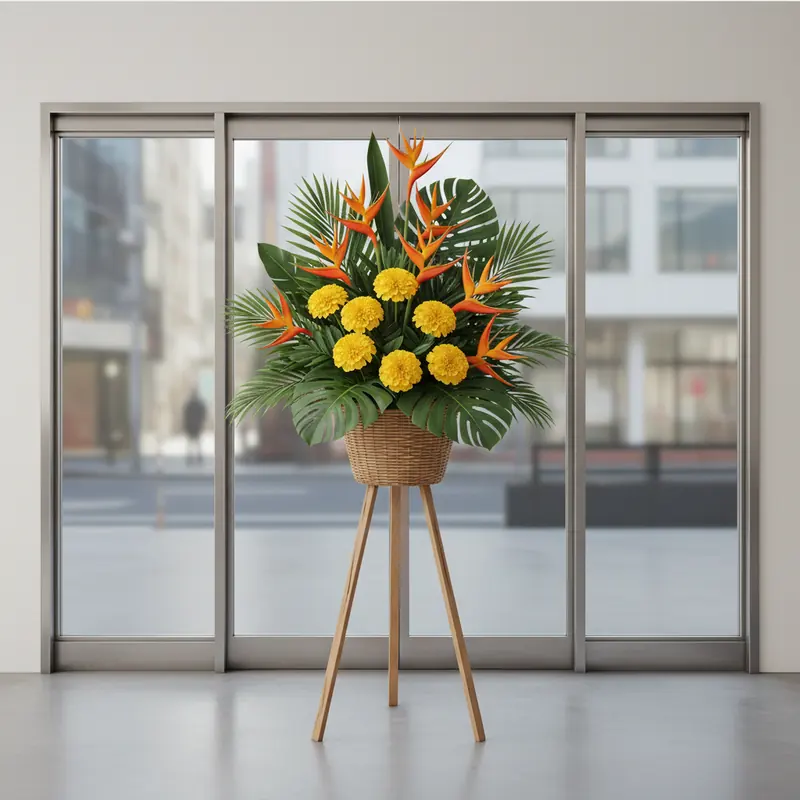
1. Identify the One Permitted Spot Before Choosing the Display
Ask the recipient to mark the proposed position on a shopfront photograph or a simple sketch. ‘Beside the entrance’ is not precise enough if it could mean either side of a door, a recessed area or a shared passage. Record which way the display should face and whether the permission covers a floor-standing item, a basket on an existing surface or another format. If approval is still pending, label the position as proposed rather than treating it as settled.
Once the recipient confirms that one display is wanted, compare a grand opening flower basket for the occasion, then ask about its actual finished outline. Venue scale is a real selection issue: Faful Florist’s opening basket guide recommends more compact choices for smaller venues or indoor shopping malls to avoid crowding. That supports checking the location first; it does not establish a universal permitted size or replace the venue’s decision.
- Permitted quantity: one display; approved position: [description or marked photograph].
- Venue or management contact who can confirm the position: [name or role].
- Permitted format and facing direction: [details or awaiting confirmation].
2. Measure the Base and the Finished Outer Outline Separately
Record the usable width, depth and any height restriction at the marked position, using the same measurement unit throughout. Show the door’s movement, the edge of the walking route and any shop sign or fitting that the venue wants kept clear. A front photograph alone cannot show depth. Add a top-down sketch, however simple, so the supplier can see which boundary is beside the wall and which faces the entrance. Ask the venue to confirm its requirements rather than inventing a clearance allowance.
Then request two sets of dimensions from the supplier: the base width and depth, and the maximum finished width, depth and total height including flowers, foliage, wrapping and the card. When comparing flower baskets, remember that the container’s dimensions are not the full display’s footprint. A low basket can spread beyond its base, just as a narrow stand can carry a wide floral top. Do not estimate either measurement from the apparent proportions of a product image.
- Available position: width [ ] × depth [ ]; height restriction [ ]; unit [ ].
- Proposed base: width [ ] × depth [ ]; maximum finished outline: width [ ] × depth [ ] × height [ ].
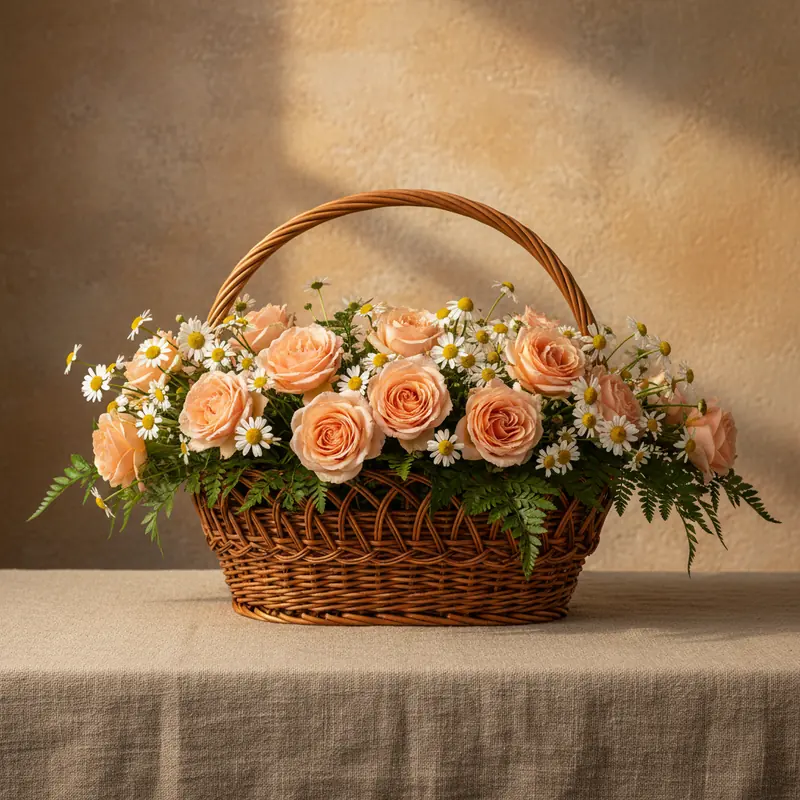
3. Compare Narrow, Low and Countertop Formats on the Same Basis
A narrow stand, a lower basket and a compact floral box solve different problems. Compare each against the same approved position rather than ranking them by height alone. A tall design may suit a narrow-looking frontage but still exceed the permitted width above the base. A lower arrangement may leave a sign visible yet occupy more surface area. The useful question is which complete outline fits the approved location while leaving the card readable in its proposed position.
A countertop arrangement is an option only if the recipient agrees to use that surface. Do not assume that a restriction outside the shop creates permission inside it. Lavish Florist’s opening basket guide describes tabletop arrangements as an option for shops with limited space. Treat that as a format to discuss, not as proof that a particular counter, reception desk or table is available. Confirm the surface and its usable area before replacing a floor-standing proposal.
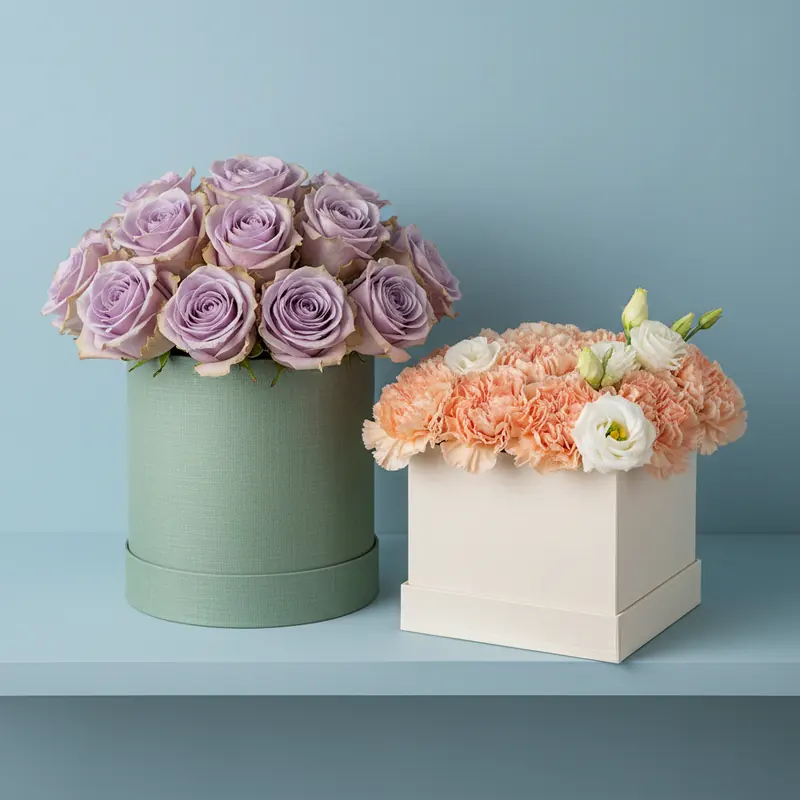
4. Turn a Style Reference into a Dimensioned Request
If an existing design’s proportions do not match the approved space, bring the sketch, maximum outer dimensions and card requirements to a bespoke floral design enquiry. Ask whether a suitable design is feasible and available for the order. Avoid requesting ‘the same but smaller’ without explaining what must change: reducing overall height may not reduce the spread of foliage or the width needed for a company name.
Label each attachment by purpose. A reference image communicates a preferred style; the location sketch communicates boundaries; the card proof communicates exact wording and, where available, layout. None is a photograph of the completed order. Ask the supplier how the finished dimensions would be described and whether any proposed substitutions could alter them. If the supplier cannot work within the confirmed limits, take that uncertainty back to the recipient instead of quietly treating the reference image as an approved specification.
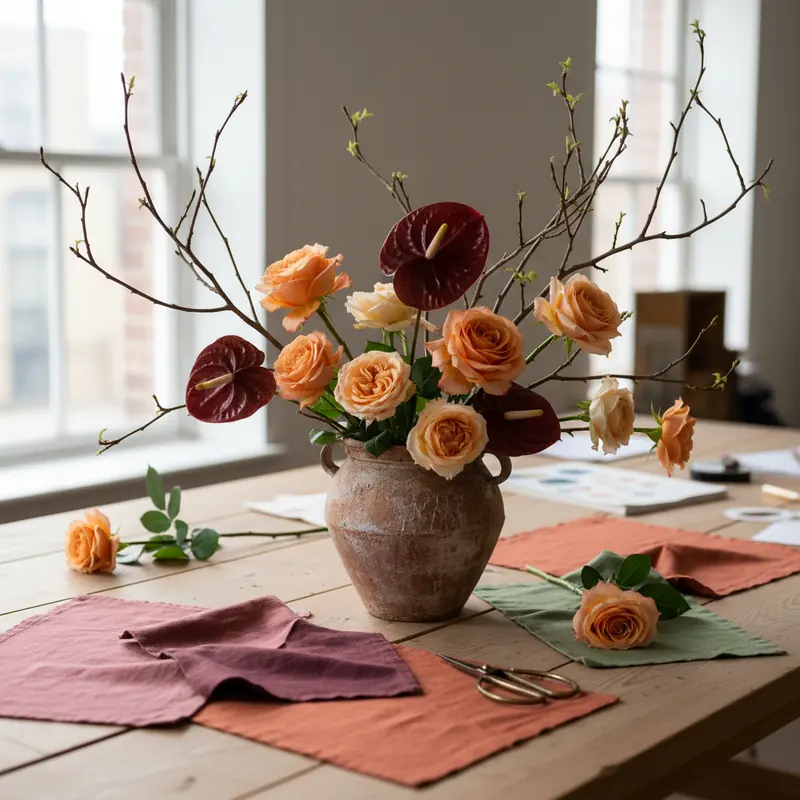
5. Include the Card in the Space Check
The card is part of the physical display, not an administrative detail added afterwards. Ask for its proposed size, orientation and position, including whether it sits above, within or beside the flowers. A card moved higher to avoid foliage changes the total height. A wider card used for a long company name may change the maximum width. Put the proposed card position on the same sketch as the base and floral outline so those relationships remain visible.
Ask how the wording will be read from the direction the venue has approved. A layout that works head-on may not work as intended after the stand is turned towards approaching visitors. Discuss whether the intended lettering and line breaks can accommodate the full approved names on the proposed card. Do not solve a layout problem by assuming the card can extend into another area or by shrinking the names without the sender’s agreement.
- Card size and orientation: [ ]; position relative to flowers: [ ].
- Card included in maximum finished width, depth and height: [confirmed or pending].
6. Proof the Recipient, Greeting and Sender as Different Fields
Write the recipient, congratulatory message and sender in separate labelled fields before discussing typography. Faful’s guide distinguishes the recipient, message and sender, while Lavish’s guide also separates recipient and giver names. This is a useful starting point for preventing a familiar mistake: correctly spelled names appearing in the wrong roles. Keep the field labels in your approval record even if those labels will not be printed on the finished card.
For the company name on an opening flower stand card, copy the authorised wording rather than reconstructing it from a shop sign or email signature. Check capitalisation, punctuation, spacing and company suffixes character by character. An instruction to ‘use our company name’ is incomplete if the business uses different trading, legal or regional names. Ask the sender which version is intended for this gift.
Recipient: Identify the Business Being Congratulated
Ask the recipient contact to supply the exact business or company name to appear on the card. If a branch, shop name or location descriptor is required, record it on its own proposed line and confirm whether it belongs in the printed message. Do not replace the recipient’s supplied name with the building name or the name of the person receiving the delivery.
Sender: Confirm Who Is Taking Credit for the Gift
Ask the gift organiser to identify the sending company, any department and any individual signature separately. A department is not automatically a substitute for the company name, and an employee arranging payment is not necessarily the named sender. Have the authorised sender contact confirm the exact printed form of each line, including any decision to omit an individual name.
- Recipient company or trading name: [exact text].
- Congratulatory greeting: [exact text].
- Sending company: [exact text]; department if needed: [exact text]; signature if needed: [exact text].
7. Resolve Long Names and Bilingual Order Before Approving Layout
If Chinese and English names are required, obtain both approved versions and specify their order. Do not translate a company name, invent an abbreviation or expand initials on someone else’s behalf. Keep punctuation and company suffixes within the supplied text. If only one language version has been approved, mark the other as outstanding rather than allowing the supplier to infer it from a website or a similar business name.
When a name is too long for the proposed layout, ask what alternatives are possible: a different line break, a revised arrangement of the text or a different card format. Any shortened name needs approval from the person authorised to decide that wording. Any larger or repositioned card needs another dimensional check. A text-only confirmation settles spelling, but it does not show whether the final line breaks and card size work together; ask what form of layout confirmation is available.
8. Give Each Person a Clear Approval Responsibility
Use the venue contact to confirm the location and applicable space restrictions, and the sender’s nominated contact to confirm the printed company wording. Ask the supplier to confirm feasibility and the services available for this order. These are different decisions. A venue contact saying the stand may go beside the door does not approve the sender’s company suffix, and a sender approving the greeting does not grant permission to use a shared passage.
Record the name or role responsible for each confirmation and the version they reviewed. If one person coordinates everything, they can collect the decisions without pretending to hold every authority themselves. Avoid a general ‘all approved’ message when one part is unresolved. State the outstanding item directly, such as ‘recipient name confirmed; maximum finished depth awaiting supplier confirmation’, so a partial response is not mistaken for approval to proceed.
9. Keep One Opening Flower Stand Approval Checklist
Combine the location sketch and line-by-line wording in a short, forwardable record. Give it a version identifier that appears on the sketch, text and any layout attachment. The fields below are a working communication aid you can copy into a message or document; they are not a supplier’s official order form. Keep unknown values visibly marked ‘pending’ rather than leaving blanks that someone else may mistake for unimportant details.
Ask whether the supplier can review the wording or provide a layout, and what amendment arrangements apply before production. The record should state what was actually reviewed: plain text, a dimensioned sketch or a proposed card layout. A style image is not evidence that a finished display has been measured, and a card proof is not venue permission. Keeping these distinctions inside one version makes it easier for each contact to approve only the part they can verify.
- Record version: [ ]; quantity: one; intended display date and district: [ ].
- Approved location and facing: [ ]; location sketch or marked photo identifier: [ ].
- Venue limits and measurement unit: [ ]; base width × depth: [ ]; finished maximum width × depth × height, including card: [ ].
- Card size, orientation and position: [ ]; proof type and attachment identifier, if available: [ ].
- Printed line 1: [ ]; line 2: [ ]; further lines: [ ]; recipient and sender roles labelled separately in this record: [ ].
- Chinese and English order, if needed: [ ]; authorised name shortening, if any: [ ].
- Venue confirmation by: [ ]; sender wording confirmation by: [ ]; supplier feasibility response: [ ].
- Delivery arrangements, amendment deadline and unresolved items to confirm with the supplier: [ ].
10. Recheck the Fields Affected by Each Change
A change need not restart every conversation, but it should reopen every affected field. A replacement base changes the footprint check. Different foliage can change the maximum spread even if the colour scheme stays the same. An extra sender line can change the card layout and possibly its dimensions. Compare vertical and horizontal flower arrangements when discussing a revised outline, while checking maximum projection and card readability together rather than treating shape as a purely decorative choice.
For a hypothetical example, suppose the sender adds a department after approving the text. First confirm the new wording with the sender’s authorised contact. Then ask the supplier whether it changes the line breaks, card size or position. If the overall outline changes, send the revised dimensions to the venue contact as well. Identify what changed in the new version; do not leave an old sketch circulating beside new card text under the same approval label.
11. Separate Placement Approval from Delivery Arrangements
Even a fully agreed display specification leaves practical questions to settle. Confirm the intended delivery date, district, receiving contact role, access instructions and any venue receiving restrictions with customer service for the individual order. Ask whether the proposed delivery arrangement includes placing the item at the agreed spot, or whether someone at the venue must receive and position it. Do not assume that permission to display an item includes permission for a courier to enter or set it up.
If the permitted position becomes unavailable, name the person who should be contacted rather than authorising an unspecified alternative. Moving the display onto a counter or into a lobby changes the location approval and may change the suitable format. Any price, delivery charge, availability or timing needs order-specific confirmation. The shared record is a way to communicate requirements, not a promise of on-site installation, a delivery slot or completion before a ceremony.
12. Release a Complete Version, Not a Trail of Corrections
Before asking the supplier to proceed, send the complete latest record with its associated attachments. State which earlier version it replaces and which confirmations remain outstanding, if any. A short handover should allow the next reader to identify the single display, its authorised position, the full outer dimensions and every printed line without searching through separate message threads. If those items disagree, resolve the conflict rather than relying on the newest-looking attachment.
Keep the agreed location explicit through the final handover. If the recipient instead approves an indoor reception arrangement, update the record to that format and surface; do not keep describing it as the original entrance stand. The objective is not the tallest or most elaborate gift. It is one appropriate display whose physical outline and company wording have been checked by the relevant people, with any supplier-dependent details clearly confirmed or still pending.
Details to confirm before ordering
- Confirm that the recipient permits exactly one display and mark its authorised position and facing direction.
- Record the venue’s available width, depth and height limits using one measurement unit.
- Request base dimensions and the full finished outline, including flowers, wrapping and card.
- Supply separate exact recipient, greeting and sender fields, with any bilingual order approved.
- Check card size, position, proposed line breaks and any authorised abbreviation.
- Keep venue, sender and supplier confirmations with the same version of the record.
- Ask customer service to confirm availability, costs, delivery arrangements and amendment terms for this order.
Questions about this decision
Can I approve the stand from a photograph alone?
Use a photograph for style and location context, not as a scale drawing. Request the base dimensions and maximum finished width, depth and height, including the card, and compare those with the venue’s confirmed limits.
What if only the base fits inside the permitted area?
That does not establish that the complete display fits. Show the venue contact the proposed outer outline, including projecting flowers, wrapping and card. Ask the supplier about a revised form if that outline exceeds the approved position.
Who should approve a shortened company name?
The contact authorised to approve that company’s printed wording should approve the shortened form. Do not let a space problem become an unapproved edit. Ask about line breaks or layout alternatives first.
Does a card proof mean the florist has accepted all the dimensions?
No. Record text or layout approval separately from confirmation of the full display dimensions. Ask the supplier which elements its response covers, and keep venue permission as a separate confirmation.
What should I do if management withdraws the agreed entrance position?
Pause the placement decision and ask the venue contact to identify an approved alternative. Send that location and its limits to the supplier before assuming the same display will work. Confirm any resulting order changes directly.
Sources and further reading
Reference only. Illustrations are AI-generated design references, not photographs of actual customer orders. Confirm current contents, prices and arrangements with our team.
For this guide:Only Room for One Opening Flower Stand? Approve Its Footprint and Company Wording
Arrange your flower order
Considering grand opening flower basket? Send the date, district and the points discussed in this guide to Y. Florist to confirm suitable options and a quotation.
Order Your FlowersWhatsAppThis opens a prepared WhatsApp enquiry. Availability, details and price must be confirmed before booking.
Explore related services and designs
Compare relevant options, view design references and find the information you need before making an enquiry.
Causeway Bay flower delivery
Compare floral formats for a Causeway Bay destination, considering the recipient's setting, arrangement size and address or access details to discuss when planning the handover.

order flowers online
Compare floral styles and practical ordering considerations, including arrangement format, colour preferences and the details to prepare when discussing an online flower request.
Hong Kong florist
Compare bouquet and arrangement formats for different gifting needs, then consider colour preferences, occasion and handover details before discussing suitable floral options.

flower delivery Yuen Long
Compare floral formats for a Yuen Long destination, considering the occasion, arrangement scale and precise address details needed when discussing access and the intended handover point.
Kowloon flower delivery
Compare bouquet and floral box formats for a Kowloon destination, considering address, access and handover preferences while asking about current delivery availability and any applicable arrangements.

same day flower delivery
Compare the floral format and destination details to discuss for a same-day request, while checking current availability and any handling or handover conditions.
Original AI-generated navigation references; designs and order details are subject to confirmation.
Useful options for your plans
Plan flower delivery Yuen Long by comparing floral formats and sharing precise address, access and handover details.
Compare Kowloon flower delivery options and confirm current availability alongside the address, access and handover preferences.
Review flower delivery Hong Kong to compare route, building access and handover considerations for your chosen flowers.
Plan next day flower delivery by comparing floral formats and confirming the recipient's destination and handover details.