Y. Florist · Ordering guides
How to Divide Tasks in a Non-Competitive Floral Workshop for a Mixed-Skill Team
For this guide:How to Divide Tasks in a Non-Competitive Floral Workshop for a Mixed-Skill Team
Plan your workshop
Considering floristry classes? Send the date, district and the points discussed in this guide to Y. Florist to confirm suitable options and a quotation.
Book a WorkshopWhatsAppThis opens a prepared WhatsApp enquiry. Availability, details and price must be confirmed before booking.
One colleague has arranged flowers before; another is hesitant even to pick up the tools. Giving the first person all the making and the second all the tidying may get an arrangement finished, but it leaves little room for either to choose how to participate. For a non-competitive session, the central question is not who can produce the best flowers. It is how each person can try a meaningful part without being rushed, compared or taken over.
Start floral workshop task allocation with a short brief: the intended outcome, the steps people may choose, the points at which work can change hands, and the help available when someone gets stuck. The approach below is a set of requests to discuss before booking, not a description of a confirmed Y. Florist programme. Availability, materials, instruction, fees and any adjustments need direct confirmation for your date and group.
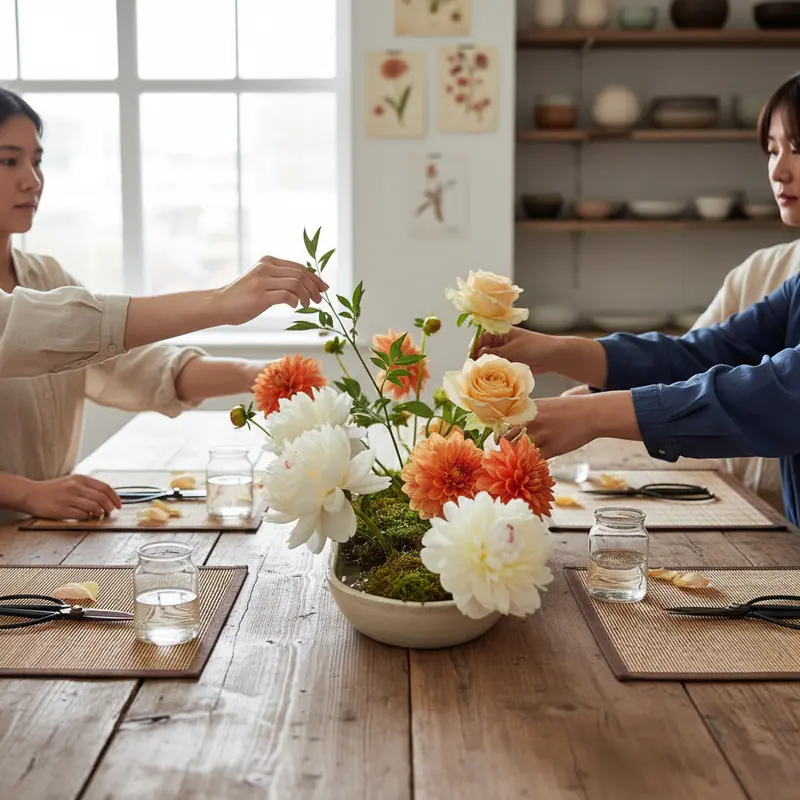
1. Define participation before choosing the workshop format
Write the purpose in observable terms: colleagues should have an opportunity to choose a task, receive a demonstration and complete a step they want to try. Leave out judging, speed awards and a final vote for the most attractive arrangement. Non-competitive should describe the host's behaviour throughout the session, not merely the absence of a prize at the end. A countdown to the fastest table can recreate the comparison you meant to avoid.
If you are still distinguishing a learning course from a one-off company activity, browse the floristry classes overview, then explain that this enquiry concerns a mixed-experience group rather than a uniform teaching pace. Decide which matters more: practising a particular technique or sharing the making. That decision helps the facilitator assess what can realistically fit, instead of treating every available project as interchangeable.
The format itself is not an unusual request: Bat Haus's discussion of floral team activities explicitly describes a non-competitive approach and collaborative group arrangements. That supports asking about this direction; it does not establish what a Hong Kong provider currently offers. The task cards and handover rules below are planning suggestions, not a standard procedure taken from that source.
2. Choose individual pieces or a shared arrangement first
Individual pieces give each colleague a clear place to make decisions and an identifiable item to take away. Shared demonstrations can still be followed by individual practice, with optional requests for a neighbour's advice. Avoid requiring everyone to exchange unfinished work simply to prove collaboration. Someone who wants to continue practising a step should be allowed to keep working on their own piece, subject to the agreed session limits.
A shared arrangement needs a different agreement: whose choices determine the overall palette, when someone can add material, and who decides whether a proposed change should be made. In a hypothetical group, one person might suggest a colour combination while another tries the first placement after a demonstration. The next participant should receive an explanation of what remains open to change, not a finished design that they are only allowed to watch.
Settle display and take-home ownership at the same time. A communal piece cannot automatically become an individual keepsake for everyone. Ask whether it will stay at the venue, go to an agreed recipient or follow another confirmed arrangement. Resolving that question early prevents wrapping and transport decisions from becoming an unplanned contest over who contributed most.

3. Collect preferences without creating ability labels
Use a short private response form rather than asking people to declare themselves beginners or experts in front of colleagues. Ask what they have tried before, which step they would like to attempt, which teaching language they prefer and whether they want to raise any participation needs privately. Leave room for uncertainty: someone may have experience with a vase arrangement but feel unfamiliar with a hand-tied bouquet.
For colleagues trying flowers for the first time, a beginner floral arrangement class can provide a reference point for the basic learning direction. Ask whether your proposed company session can include the relevant introductory demonstrations; do not make another class a prerequisite for joining. Equally, previous experience should not remove someone's opportunity to receive an explanation or ask a basic question.
If your enquiry uses the phrase mixed ability floral workshop, explain that you mean differences in floristry experience and confidence with hand-making. It should not stand in for assumptions about disability, health or access. Invite people to volunteer concerns about materials, fragrance, contact or tool use, and ask the provider what can be accommodated. Do not circulate personal explanations around the table or assume the selected format suits everyone.
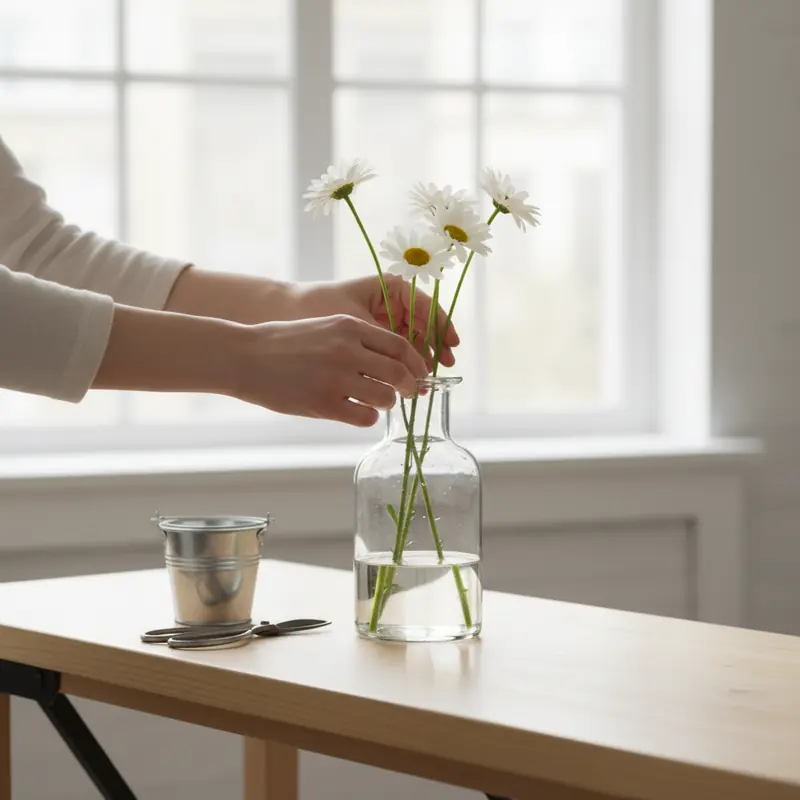
4. Agree how demonstrations and requests for help will work
Ask for a common demonstration before participants choose how to proceed. Confirm how people will see it, whether the relevant explanation can be repeated and how they should request individual help. A discreet request can be as simple as saying, 'Please show me that step again.' Do not rely on the most confident colleague to notice every question or translate technical instructions without prior agreement.
There is a useful precedent for asking rather than assuming: Earth Within's private workshop description mentions guests of different skill levels and individual guidance. Those are that provider's descriptions, not evidence of a particular instructor ratio or local service. In your own enquiry, describe the help required and ask who would provide it, including what happens if several tables need assistance together.
Agree what happens while someone waits. They might pause their piece, consider their next colour choice or observe a demonstration by invitation. They should not have to surrender their work to a colleague just to keep the table moving. Ask the facilitator where unfinished work can rest and which steps should stop until guidance is available.
5. Make task cards describe choices, help and a ready-to-pass point
A useful card names the task, the choices available, the demonstration required, the handover condition and an alternative way to contribute. It does not name the 'best' person for the job. Keep the cards beside the relevant work area and let participants express preferences before allocating turns. Selecting materials, preparing them, arranging and finishing should all remain available to interested colleagues, rather than becoming a ladder from junior helper to senior maker.
For colour and material selection, invite each person to suggest an option from the materials the facilitator has approved. Agree the group's direction before preparation begins, then hand over a clearly identified selection with any unresolved choices stated. If the group cannot agree, ask the facilitator to explain the workable options rather than letting the most senior employee decide by default. A participant can contribute by describing a preferred contrast or shape without handling the materials.
Example card: preparing materials after instruction
Task: prepare only the materials and steps demonstrated by the facilitator. Choice: try the demonstrated action, ask for guided assistance or select an agreed non-tool contribution. Ready to pass: the facilitator has confirmed the preparation is suitable for the next step, and any unfinished work is identified. Help route: pause and request a repeat demonstration rather than improvising with unfamiliar cutting, wiring or small components. The precise method must come from the instructor for the chosen project.
Example card: placing or assembling part of the design
Task: make an agreed contribution to the arrangement. Choice: select the next element, try its placement after instruction or ask the facilitator to demonstrate while explaining your design choice. Ready to pass: say what you have done, what you want left unchanged and what remains undecided. Help route: ask before removing another person's contribution. Rotation is an option, not an obligation; agree a suitable stopping point if someone prefers not to change roles.
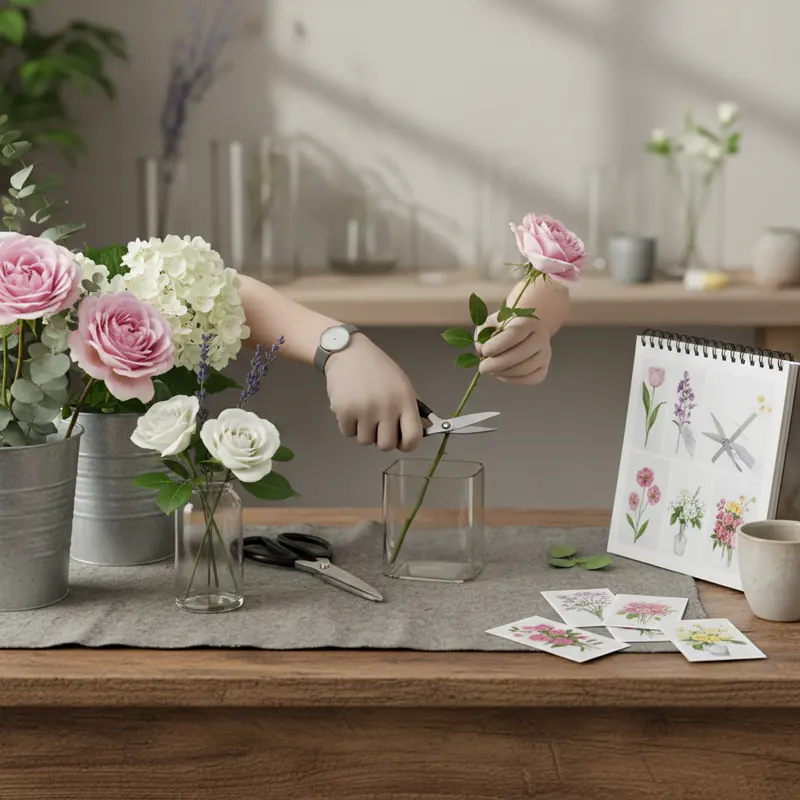
6. Plan fresh-bouquet handovers around the making method
A shared bouquet is not necessarily a sequence of independent actions that can be passed around at any moment. When considering a bouquet making workshop, ask which stages of selecting, holding, tying and wrapping can be separated, and which require continuity. Do not prescribe a hand-to-hand change while someone is holding an unfinished bundle. The instructor should confirm whether a pause, support method or demonstration-led alternative is appropriate.
Build the handover around a confirmed checkpoint, not the expiry of an arbitrary turn. Before changing participants, the current maker can explain what has been selected and what still needs attention; the facilitator can confirm whether the work is ready to transfer. If holding the bouquet must remain continuous, another colleague could choose the next material or observe the technique, with a separate opportunity to practise where feasible. Ask for that opportunity rather than counting observation as equivalent to hands-on practice.
For individual bouquets, keep ownership clear when neighbours help. 'Would you like me to show you?' is different from reaching in and rebuilding someone else's work. Request a rule that advice, a demonstration and taking over are separate actions, each requiring permission. This gives experienced participants a useful supporting role without making the finished piece their decision.

7. Rebuild the task map if you choose preserved flowers
Changing the material does not simply remove the difficult parts of a fresh-flower project. If you are considering preserved flower workshops, ask whether the proposed design involves wiring, small components or other tools, and which preparation steps the facilitator could undertake if agreed. Confirm the actual project before deciding how to divide it; do not describe preserved flowers as automatically easier, safer or free of handling requirements.
Petaleon's article on flower-arranging workshops discusses shared tasks and preserved-flower materials with step-by-step guidance. It establishes a relevant combination of format and material, not the suitability of a particular project for your colleagues. Ask the prospective provider for a sequence of tasks so you can distinguish design decisions from preparation and assembly, rather than copying the fresh-bouquet rotation unchanged.
If a participant does not wish to handle a component, discuss a meaningful alternative within the same design process: choosing from approved materials, describing a placement or planning a label. Confirm whether that alternative is available and acceptable to the participant. Pre-preparation may change what people get to practise, so state explicitly which hands-on steps you still want to retain.
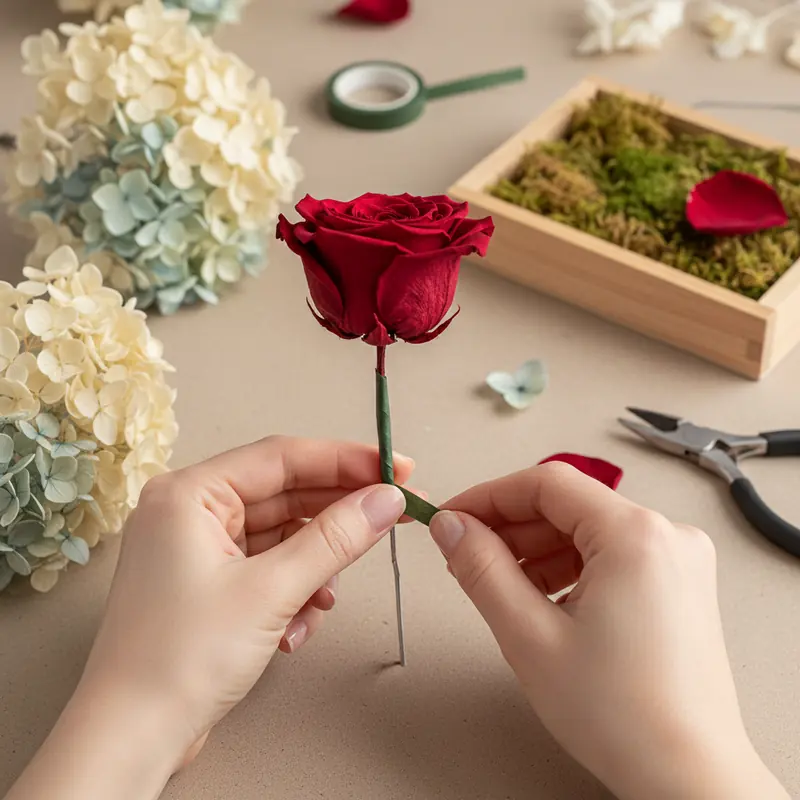
8. Give experienced makers a supporting role without ownership of everyone else's work
Explain the support rule before the first task: offer advice, ask permission and return the decision to the maker. An experienced colleague may demonstrate a step if invited and if the facilitator agrees, but should not quietly complete the remainder. Useful prompts include, 'Would you like another demonstration or time to try?' and, 'Which part would you like help with?' Neither question assumes that hesitation is permission to take over.
Avoid making the experienced person the permanent unpaid instructor, too. They joined the activity and may want to try an unfamiliar task. Let them decline a helping role, return to their own piece or request guidance. If they finish early, ask the facilitator about an optional extension that does not turn into a more advanced entry for everyone else to compare against.
Managers should follow the same rules as other participants. Do not automatically give them final design approval, or allocate preparation and clearing to junior colleagues. If a disagreement arises over a shared arrangement, return to the agreed brief and ask the facilitator to clarify feasible choices. The organisational hierarchy need not determine who gets the creative decisions.
9. Offer alternatives without trapping someone in a helper role
Optional participation works best when the alternative has a visible connection to the project. Someone who declines a tool-based step might choose materials, explain a design preference or work on a label if those options are agreed. Ask what they would like to do, rather than handing them discarded wrapping to clear away. Choosing not to attempt one step should not remove their invitation to try the next.
Distinguish a preference not to rotate from being excluded from rotation. A participant may enjoy continuing with one stage; another may be waiting for a turn but reluctant to interrupt. The host can check privately whether each person wants to stay, swap or ask for help. Avoid public explanations about why a colleague is using an alternative, and do not promise that every requested adjustment can be provided before the supplier has reviewed it.
10. Treat wrapping, labelling and clear-up as shared work
Wrapping and labelling are opportunities to make choices, not consolation jobs reserved for people who did not arrange flowers. Ask who would like to try the demonstrated finish, what assistance is available and when the piece is ready to package. For an individual arrangement, its maker should approve the label and presentation. For a shared piece, confirm the agreed recipient and display destination before anyone writes a name on it.
Separate the handover to packaging from the final collection. Ask the facilitator to confirm how the piece should be supported and what materials or instructions accompany it. If something is not ready, identify who will help rather than letting a faster colleague rework it without asking. Any proposed carrying or display arrangement must match the provider's guidance for that project.
Reserve clear-up as a whole-group stage, with tasks the facilitator identifies as appropriate. Do not leave beginners clearing while experienced makers continue adding finishing touches indefinitely. Agree where unused materials and tools should go and who handles anything requiring instructor attention. Completion means reaching the agreed stopping point together, not rewarding the table that packs away first.
11. Send a brief the facilitator can assess before you book
When asking about a private floral workshop, explain the adjustments you are requesting: optional tasks, repeated demonstrations, permission to remain in a role and no scoring or ranking. Ask whether the flow can be adapted, what alternatives are possible and which conditions apply. A private format is a reason to enquire about flexibility, not proof that every adjustment, material or date is available.
Include estimated headcount, date window, Hong Kong district, venue type, teaching language and the available activity window. Then add the participation decisions: individual or shared work, desired practice steps, proposed handover points and how assistance should be requested. Send only the participation information colleagues have agreed to share; the provider does not need an organiser's speculative account of anyone's health or ability.
State the fallback if time becomes tight. Ask which materials could be prepared in advance, which decorative choices could be omitted and which participant-selected steps should be protected. Do not let 'finish everything' become an instruction for the instructor or the fastest maker to take over all remaining work. Ask the provider to explain what a realistic stopping point would look like.
12. Check the written reply, then review participation rather than appearance
Send the completed brief with your team building floral workshop enquiry, rather than sending only a date and headcount. Request a written reply covering current availability, proposed project, materials and tools, instruction arrangements, alternatives, fees and booking terms. If the reply offers a fixed demonstration followed by a timed challenge, clarify the mismatch before proceeding. Your non-competitive requirement needs explicit agreement, not an assumption based on the word 'team'.
Read the reply against the difficult moments you have identified. Who helps when several people need a repeat demonstration? Can someone decline a tool or remain with a task? What happens to an unfinished shared piece? A provider may explain that a requested rotation is unsuitable for the chosen method. You can then consider another project or a different division of tasks instead of forcing an impractical sequence.
Afterwards, ask whether participants could choose and attempt the steps they wanted, whether help was available and whether anyone felt their work was taken over. Use those answers to refine the next brief, without scoring the flowers or naming a winning colleague. This is a practical way to review participation; it is not evidence of improved productivity, mental health or team performance.
Details to confirm before ordering
- Confirm the date window, district, venue type, estimated headcount, teaching language and activity window.
- Choose individual pieces or a shared arrangement, and agree display, collection and take-home ownership.
- State no scoring, speed prizes, appearance rankings or compulsory public comparison.
- Identify participant-selected practice steps, optional rotations and method-appropriate handover points.
- Confirm demonstrations, the help-request process and how simultaneous requests for assistance will be handled.
- Ask which alternatives and advance preparation are feasible, while sharing only agreed participation information.
- Obtain written confirmation of current availability, materials and tools, finishing and clear-up arrangements, fees and booking terms.
Questions about this decision
Should every participant rotate through every task?
No. Offer turns at suitable handover points, but let people remain with a task or decline a step. Check whether staying is their choice rather than the result of someone else taking over. The facilitator must confirm which changes of hands are workable for the project.
What if one experienced colleague keeps correcting everyone else's flowers?
Restate the permission rule: offer advice first, demonstrate only when invited and leave decisions with the maker. Ask the facilitator to handle technical questions. Do not give the experienced colleague responsibility for completing everyone else's work.
Can someone participate without cutting stems or using wire?
Ask the provider about meaningful alternatives such as selecting approved materials, directing a design choice or labelling. Confirm the options with the participant before booking. Their availability depends on the project, materials and instruction arrangements; do not assume every tool-based task can be replaced.
How do we avoid judging while still displaying the finished flowers?
Agree a neutral display without awards, votes or fastest-table announcements. Invite people to describe a choice they made or a step they tried, without requiring a public presentation. For shared work, settle the recipient or display location before the activity.
Does this guide confirm that Y. Florist can provide the proposed format?
No. It provides a brief for an availability enquiry. Ask Y. Florist to confirm the project, date, group arrangements, assistance, materials, fees and terms before relying on any proposed activity or adjustment.
Sources and further reading
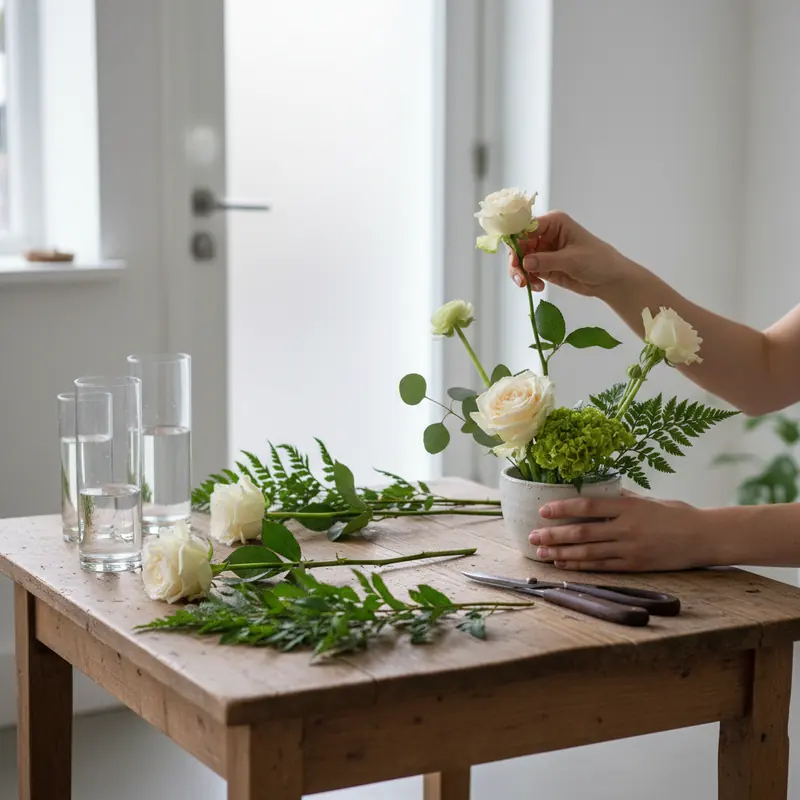
Reference only. Illustrations are AI-generated design references, not photographs of actual customer orders. Confirm current contents, prices and arrangements with our team.
For this guide:How to Divide Tasks in a Non-Competitive Floral Workshop for a Mixed-Skill Team
Plan your workshop
Considering floristry classes? Send the date, district and the points discussed in this guide to Y. Florist to confirm suitable options and a quotation.
Book a WorkshopWhatsAppThis opens a prepared WhatsApp enquiry. Availability, details and price must be confirmed before booking.
Explore related services and designs
Compare relevant options, view design references and find the information you need before making an enquiry.
preserved flower workshops
Compare preserved-flower crafting themes, material textures and arrangement formats, considering the practical tools and session details to ask about while confirming current workshop availability before booking.
floristry classes
Compare floristry learning formats such as introductory, seasonal or group sessions, considering the floral techniques, materials and booking details to ask about before choosing a class.
private floral workshop
Compare floral themes and practical learning formats for a private workshop enquiry, considering preferred materials, group needs and the session arrangements to discuss before booking.
beginner floral arrangement class
Compare beginner learning topics including flower selection, conditioning, simple arranging and care, considering the hands-on materials and class details to ask about before booking a session.
team building floral workshop
Compare collaborative floral activities, shared materials and group learning formats, considering how a team workshop theme and session arrangement could fit your participants' preferences for learning.
bouquet making workshop
Compare bouquet-making learning topics such as stem selection, hand-tied shaping and wrapping, considering the practical materials and session details to discuss before choosing a workshop.
Original AI-generated navigation references; designs and order details are subject to confirmation.
Useful options for your plans
Compare preserved flower workshops by crafting theme, materials and session details, and check current availability before booking.
Explore floristry classes to compare learning formats, floral techniques and the booking details to ask about.
Compare a private floral workshop by floral theme, materials and session format for your group's learning preferences.
Explore a beginner floral arrangement class to compare flower conditioning, simple arranging and care topics before booking.